

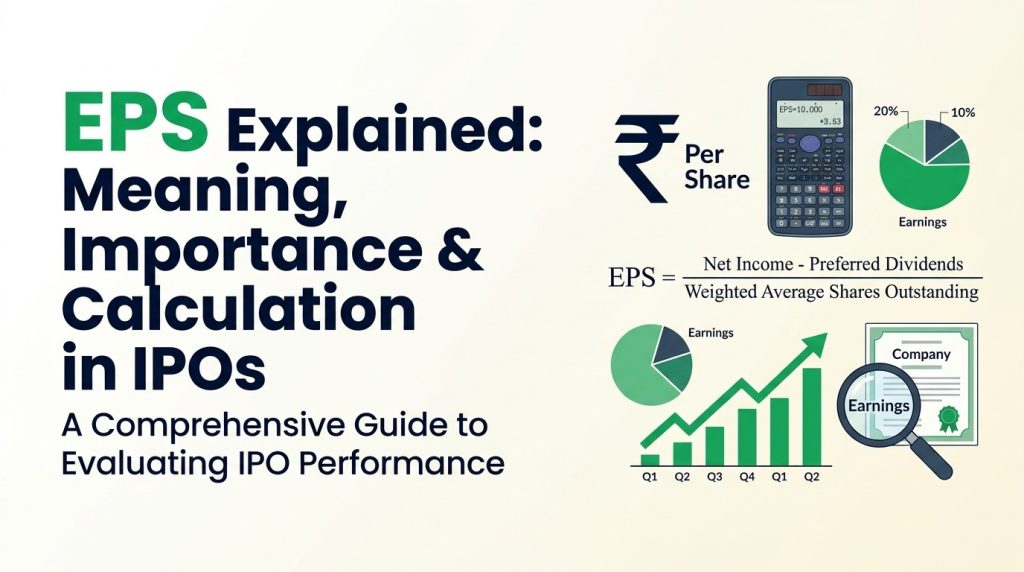
What is EPS?
EPS (Earnings Per Share) is an important financial metric that shows how much profit a company earns for each share of its stock. This is mostly used by the capital provider and analysts to check a company’s profitability.
What is the full form of EPS?
EPS full form: Earnings per share
Earnings per Share Formula: (Net Income – Preferred Dividends) ÷ Weighted Average Common Shares Outstanding.
Before investing in Mainboard IPOs & SME IPOs, one should always check the company’s EPS, which can help determine how much the company has been earning per share.
Why considering EPS is important in the upcoming IPO?
Keeping EPS in mind is essential for the upcoming IPOs because it gives clarity about the company and how much profit the firm is making on each share.
Not only checking profit, but the earnings per share define a lot of necessary factors about the company, including the company’s valuations, peer comparison, which is helpful for the capital provider before making an IPO investment decision.
So let’s know in-depth and have a better understanding of the content below.
1. Profitability
EPS plays a crucial role in the company’s financial fundamentals, as this helps to check the company’s profitability.
How much the company is getting from a single share indicates the company’s earning capacity.
2. Check valuation
EPS is useful for finding out the P/E ratio, which is helpful to check a company’s valuation. And the P/E ratio shows how much money investors are paying for a share.
By checking the valuation and comparing it with the valuation for IPOs, investors can check whether the IPO is undervalued or overvalued.
3. Financial statement
If the company’s EPS is high, that indicates the company is earning more on each share. If the EPS is low, that indicates the company is not earning as well.
4. Assist in investment
Checking EPS, and if it’s high, investors can be confident about their long-term investment decision. However, other necessary factors should also be taken care of while investing.
How to calculate EPS?
The content below helps one to calculate EPS with the explanation of each point.
The formula explanation:
- Net profit: it is the profit after all the necessary deductions from the revenue.
- Preferred dividend: The company has announced a dividend to the investors.
- Common outstanding shares: Common outstanding shares are the total number of a company’s common stock shares that are currently held by all shareholders, including retail investors, institutional investors, and company insiders.
For example:
earnings per share formula = Net profit- preferred dividend/ Common outstanding shares.
₹1 per share = ₹100 Cr/ ₹100 Cr
Upcoming IPOs with the EPS numbers
| Upcoming IPos | EPS |
| Powerica | ₹15.26 |
| Sai Parenteral’s | ₹5.43 |
| Central Mine Planning (CMPDI) | ₹9.3 |
Conclusion:
Revenue and other financial factors, including ROE and ROCE, show how well a company’s business is growing, but EPS indicates how much earnings the company has on its own share. This is helpful for more clarity and good for making an IPO decision.
However, always remember that it’s just one piece of the puzzle. And one should always look at the company’s overall growth, revenue trends, and future potential.