




Q-Line Biotech NSE SME IPO review

  • The company is engaged in the business of developing, manufacturing and marketing of diverse range of reagents and consumables.
  • It posted growth in its top lines for the reported periods, but suffered a setback for FY25 in bottom line following accounting adjustments.
  • As the company has no listed peers, it is trying to extract fancy price for its IPO.
  • Based on its overall financial data, the issue appears fully priced.
  • Well-informed investors may park moderate funds for long term.
Dilip Davda

About Company

Q-Line Biotech Ltd. (QBL) is engaged in the business of developing, manufacturing and marketing of diverse range of reagents (including kits and POC devices) & consumables and manufacturing, importing, distribution/supply of diagnostic equipment for different diagnostic healthcare needs. The company supplies diagnostic equipment and IVD products for different diagnostic healthcare needs since 2013 directly or through its distributor/s majorly to diagnostic service providers, hospitals and medical colleges. 

The company has established its brands over a period of 12 years through its experience, R & D, manufacturing capabilities and quality assurance. The core segments of operations of the Company in IVD Industry include Clinical Chemistry, Haematology, Immunodiagnostics, Molecular Diagnostics and Others (POC Devices & Rapids).

QBL’s key manufacturing segments include indigenous manufacturing of reagents including Clinical Chemistry, Haematology, Immunodiagnostics, Molecular Diagnostics and Others (POC Devices & Rapids) and supplying/ manufacturing of in-vitro diagnostics (IVD), Pathology equipment’s & devices. Further during the Covid-19 pandemic, the company diversified its focus and with the technical collaboration of third-party institutes and through its own R&D team developed a range of Covid testing kits viz. RT-PCR Kits, RNA Extraction Kits, VTM Kits etc.

It is research driven company engaged in developing and manufacturing a wide range of reagents formulations used across various IVD and diagnostic needs. The company leverages its R&D capabilities to develop and manufacture a portfolio of differentiated reagent formulations /products. Further, for its certain Class of Reagent & equipment’s and devices manufacturing business, the company has entered into technical collaboration with certain international companies. Under the agreement terms, it undertakes the manufacturing of these Reagent and equipment’s and devices as per the technical collaboration and specifications provided by the partners or companies. 

With the help of these collaborations the equipment and devices adhere to strict quality control, international standards and certifications. As of March 31, 2026, the company employed 19 personnel at R&D laboratories, which constituted 5.25% of its total permanent employee strength. As of March 31, 2026, it had 362 employees on its payroll and additional 223 contract employees in various departments.

Q-Line Biotech IPO

Issue Details / Capital History

The company is coming out with its maiden book building route IPO of 6253200 equity shares of Rs. 10 each to mobilize Rs. 214.48 cr. at the upper cap. The company has announced a price band of Rs. 326 - Rs. 343 per share.  The minimum application to be made is for 800 shares and in multiples of 400 shares thereon, thereafter. The IPO opens for subscription on May 21, 2026, and will close on May 25, 2026. The IPO constitute 26.81% of the post-IPO paid-up capital of the company. The shares will be listed on NSE SME Emerge. From the net proceeds of the IPO, it will utilize Rs. 93.50 cr. for working capital, Rs. 90.00 cr. for repayment/prepayment of certain borrowings, and the rest for general corporate purposes. 

The company raised Rs. 27.44 cr. in a pre-IPO placement of 800000 shares in May 2026, at Rs. 343 per share.

The IPO is jointly lead managed by Hem Securities Ltd., and Share India Capital Services Pvt. Ltd., Purva Sharegistry (India) Pvt. Ltd., is the registrar to the issue. HEM group’s Hem Finlease Pvt. Ltd., is the market maker as well as a syndicate member.

The company has issued initial equity capital at par value. It raised further equity shares in the price range of Rs. 125 – Rs. 417 between March 2019 and May 2026. It has also issued bonus shares in the ratio of 2 for 1 in March 2016, and 9 for 1 in August 2025. The average cost of acquisition of shares by the promoters is Rs. 0.00, Rs. 0.04, and Rs. 18.34 per share.

Post-IPO, company’s current paid-up equity capital of Rs. 17.07 cr. will stand enhanced to Rs. 23.33 cr. Based on the upper band of the IPO pricing, the company is looking for a market cap of Rs. 800.16 cr. 

IPO Lead Managers & Registrar

Financial Performance

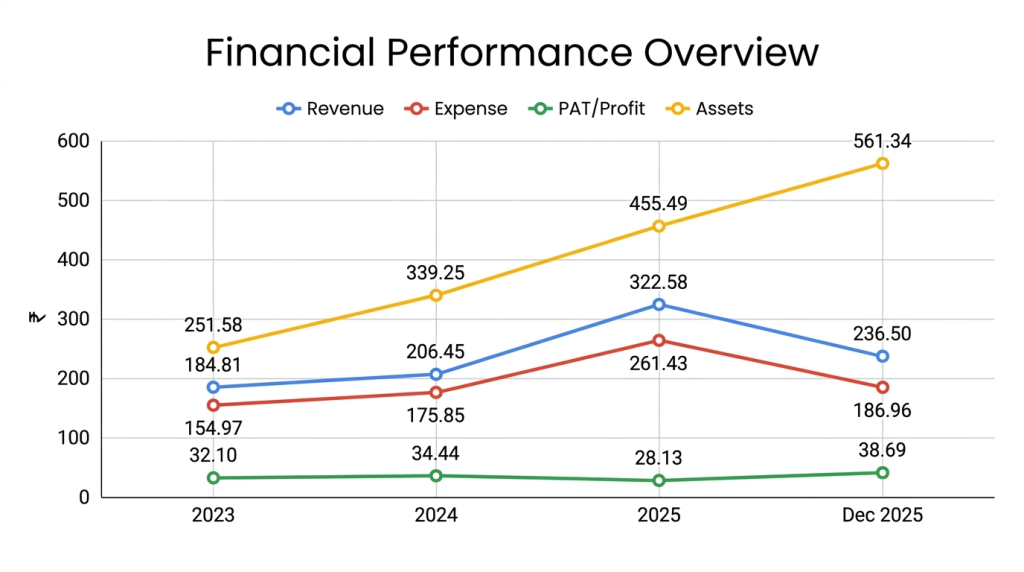
On the financial performance front, for the last three fiscals, the company has (on a consolidated basis) posted total income/ net profit, of Rs. 184.81 cr. / Rs. 32.10 cr. (FY23), Rs. 206.45 cr. / Rs. 34.44 cr. (FY24), Rs. 322.58 cr. / Rs. 28.13 cr. (FY25). For 9M of FY26 ended on December 31, 2025, it earned a net profit of Rs. 38.69 cr. on a total income of Rs. 236.50 cr. Though it posted growth in its top lines for the reported periods, its bottom line posted inconsistency. For FY25, it posted lower net profit of Rs. 28.13 cr., and for 9M-FY26, though the top line is Rs, 236.50 cr. it posted bumper profit of Rs. 38.69 cr. in a pre-IPO period, that not only raise eyebrows, but also concern over its sustainability going forward. Despite higher other income for FY25, it marked lower net following extra-ordinary item of Rs. 16.97 cr. Its contingent liability stood at Rs. 61.64 cr. as of December 31, 2025, that raises alarm. Its overall borrowings of Rs. 242.57 cr. as of December 31, 2025, raise concern.

For the last two fiscals, the company has reported an average EPS of Rs. 25.00, and an average RoNW of 23.17%. The issue is priced at a P/BV of 2.44 based on its NAV of Rs. 140.81 per share as of December 31, 2025, but its post-IPO NAV data is missing from the offer documents.

If we attribute FY26 super earnings to its post-IPO fully diluted paid-up equity capital, then the asking price is at a P/E of 15.51, and based on FY25 earnings, the P/E stands at 28.44. The issue appears fully priced, based on its bumper earnings for 9M-FY26, which may not be sustained. 

For the reported periods, the company has posted PAT margins of 17.56% (FY23), 16.92% (FY24), 8.97% (FY25), 16.65% (9M-FY26), and RoCE margins of 22.14%, 19.25%, 17.66%, 13.32%, respectively, for referred periods.

All amounts in Indian Rupees crores

Period Ended Revenue Expense PAT Assets
2023 ₹184.81 ₹154.97 ₹32.10 ₹251.58
2024 ₹206.45 ₹175.85 ₹34.44 ₹339.25
2025 ₹322.58 ₹261.43 ₹28.13 ₹455.49
Dec 2025 ₹236.50 ₹186.96 ₹38.69 ₹561.34

Dividend Policy

The company has not paid any dividends for the reported periods of the offer document. It will adopt a prudent dividend policy, based on its financial performance and future prospects. 

Comparison with Listed Peers - for Fiscal 2025

As per the offer document, the company has no listed peers to compare with.

Name of the Company Face Value (₹) EPS basic (₹)Ā  EPS Diluted (₹) RONW (%) P/E Ratio NAV (₹)
Powerica Limited 5 15.26Ā  15.26 15.37 %Ā  24.45 99.76
Listed Peers
Cummins India Limited 2 72.15Ā  72.15 26.45% 64.13Ā  272.78
Kirloskar Oil Engines Limited 2 33.71 33.60 15.85% 43.24 212.60
NTPC Green Energy Limited 10 0.67 0.67 2.58% 129.40 21.88
Acme Solar Holdings Limited 2 4.55 4.53 5.59% 50.74Ā  74.54
Adani Green Energy Limited 10 8.37 8.37 11.90%Ā  101.53Ā  76.62
Disclaimer: Above table shows earnings and P/E ratio as of 2025-26

Merchant Banker's Track Record

The two merchant bankers associated with this issue have handled 79 issues in the past three years, out of which 8 issues closed below the issue price on listing date.

Conclusion - Apply for medium to long term

QBL is engaged in the business of developing, manufacturing and marketing of diverse range of reagents and consumables. It posted growth in its top lines for the reported periods, but suffered a setback for FY25 in bottom line following accounting adjustments. As the company has no listed peers, it is trying to extract fancy price for its IPO. Based on its overall financial data, the issue appears fully priced. Well-informed investors may park moderate funds for long term.

Dilip Davda is a veteran financial journalist associated with the Indian stock market since 1978. He has been contributing to print and electronic media on capital markets, insurance, and finance since 1985.

He is widely recognized for reviewing public issues and non-convertible debentures (NCDs) in the primary market. Drawing on over three decades of market experience and close interaction with merchant bankers, his reviews focus on detailed fundamental and financial analysis of companies, with a special emphasis on SME public issues.

Disclaimer: The information provided herein is solely for educational and informational purposes and does not constitute an offer, solicitation, or recommendation to buy or sell any securities. Readers are advised to consult a qualified financial advisor before making any investment decisions. Investments in the securities market are subject to market risks. The author does not intend to invest in the securities discussed.

FAQ Accordion
Q-Line Biotech IPO FAQs
1. What is Q-Line Biotech IPO? āŒ„
Q-Line Biotech IPO is SME IPO. The company is going to raise ₹214 Crores via IPO. The issue is priced at ₹326 to ₹343 per equity share. The IPO is to be listed on NSE SME.
2. When Q-Line Biotech IPO will open for subscription? āŒ„
The IPO is to open on May 21, 2026 for QIB, NII, and Retail Investors. The IPO will close on May 25,2026.
3. What is Q-Line Biotech IPO Investors Portion? āŒ„
The investors’ portion for QIB is 50%, NII is 15%, and Retail is 35%.
4. How to Apply the Q-Line Biotech IPO? āŒ„
You can apply for Q-Line Biotech IPO via ASBA online via your bank account. You can also apply for ASBA online via UPI through your stock brokers. You can also apply via your stock brokers by filling up the offline form.
5. What is Q-Line Biotech IPO Issue Size? āŒ„
Q-Line Biotech IPO issue size is ₹214 crores.
6. What is Q-Line Biotech IPO Price Band? āŒ„
Q-Line Biotech IPO Price Band is ₹326 to ₹343.
7. What is Q-Line Biotech IPO Lot Size? āŒ„
The minimum bid is 800 Shares with ₹2,74,400 amount.
8. What is the Q-Line Biotech IPO Allotment Date? āŒ„
Q-Line Biotech IPO allotment date is May 26,2026.
9. What is the Q-Line Biotech IPO Listing Date? āŒ„
Q-Line Biotech IPO listing date is May 29, 2026. The IPO is to list on NSE SME.

Why Most Startups Show Profits Before Launching an IPO?

Profit is a significant reason for companies to expand their business. It not only enhances business but also makes the company reliable and trustworthy from the individual's perspective.

There are various mainboard IPO companies and SME IPO companies that have earned good profits before launching an IPO. However, why do startup IPO need to show profit and how? Are given below.
Upcoming IPO This Week

Right Arrow The reasons for IPO launching companies show profit:

A startup IPO is often motivated by profit, which allows the business to scale faster. 

An IPO is not a sudden decision; it’s a plan from the companies, so private companies start to spend less and focus on business profitability. Further, their earlier investment could also contribute to the profitability before the IPO. 

Infact the investors also choose the safer and more reputable companies for investment. So, companies often try to show profits just before an IPO to make themselves more attractive and make individuals perceive their company’s financial fundamentals. 

Another reason is valuation. Profitable companies often get better valuations in the stock market. Higher profits can justify higher share prices, helping founders and early investors earn more from the IPO.

Sometimes, companies suddenly show high profits right before an IPO. This can happen because they are making more profit from each sale (better unit economics) or because earlier investments are now starting to pay off.

Right Arrow What are the methods for showing profit early?

IPO launching companies have various ideas to generate a profit and appear in the records, in line with the aim of the IPO. Every company knows that investors are always attracted to companies that have stable and continuous growth. 

Therefore, the companies have varied types of steps for profit before an IPO, which are given below. 

āž¦ Quick Revenue Increment 

Startup IPO companies, take care of a quick revenue increment, wherein they focus on marketing and selling their products, so there is a higher chance to earn high profit before an IPO. 

Secondly, a private limited company also has attention on fewer expenses (reducing expenses as much as possible), aiming for high profit. 

Especially, making sales campaigns and making people more aware of their exclusive products is also a genuine way for profit for IPO launching companies. 

āž¦ Accounting choice

Capitalizing costs is a way of profit. Wherein mostly companies delay their expenses rather than immediately. Therefore, the new companies could focus on higher profits. 

āž¦ Changing Depreciation Method

  • Changing the depreciation method is useful for companies to represent high profits. Straight-line depreciation spreads an asset’s cost evenly over its life, so the yearly expense stays the same, and profits appear better.
  • Rather, an accelerated method, wherein more depreciation occurs in the early years of an asset’s life and less in the later years. 
  • The straight line method in depreciation helps stabilize financial statements and helps attract investors.  

āž¦ To Quate and example:

1. Straight Line Method

Software life: 5 years

In the straight line method, Depreciation cut the same for 5 years. 

Product’s NameSoftware
Actual Cost70,000
Salvage Value20,000
Other Expenses20,000
Depreciation (every year)10,000
Profit40,000

2. Accelerated Method 

Software life: 5 years

In the Accelerated Method, all depreciation is cut in the first year.

Product’s NameSoftware
Actual Cost70,000
Salvage Value20,000
Other Expenses20,000
Depreciation 50,000
Profit0

Right Arrow Examples of other companies 

In 2026, various companies are going public via launching a Mainboard IPO. They have also generated satisfactory profit before an IPO. 

For example a XYZ company is planning to go public in 2026. In just the first and second quarters, they have cut their cash burn by 65%: They are spending a lot less money than before, 65% cut down, and improved EBITDA by 2% points. 

However, it’s important for investors to understand whether this profit is sustainable or just a temporary peak in the business cycle. Sudden profits can be attractive, but they don’t always mean the company will continue growing at the same pace.

Right Arrow Risk and Concerns 

ā€œEvery coin has two sides.ā€ Startup IPO companies show profit, which also has risks and concerns, as given below.

  1. Owing to representing profit before the IPO, many companies could cut significant expenses, including marketing, hiring, innovation, and many more. 
  2. A startup may rely on capitalizing a cost and the depreciation method. This may be legally allowed, but it could inflate earnings without improving cash flow. 
  3. Mostly, it can affect beginner investors because they think that profit is the strong point of the companies, and it shows how much firms are earning, but in reality, they do not have an understanding of capitalising a cost and depreciation methods. Moreover, they don’t know about the economics units, real cash flows, and business stability, and a capital provider could make the wrong investment decision. 
  4. Investors should carefully check a company that suddenly goes from losses to profits right before its IPO, especially if the latest year shows a big jump in profit.
  5. Investors should check the Company’s growth plan and the Industry’s growth. 
  6. Looking into industry growth allows investors to make future predictions, including does IPO sector is booming. Would it have strong demand aftersometimes? At the same time, is the company’s strong growth plan, mission, and vision worth it?
  7. Additionally, capital providers also need to check the IPO launching company’s PE ratio, peer group PE ratio, and industry’s PE ratio. They receive information on whether the startup IPO is undervalued or overvalued. 
  8. Further, CAGR (Compound Annual Growth Rate) shows the company’s past revenue and profit CAGR to know the consistency and sustainability of growth.

Right Arrow ConclusionĀ 

Showing profit before launching IPO is the finest way for a company to get trust from the public and make an image in the market. However, the short-term profit methods, such as the less expensive, straight-line depreciation method, and quickly revenue-earning, and others, are the methods that could be used for the profit before an IPO. 

Everything has pros and cons, so we are suggesting investors should have in-depth knowledge regarding IPO companies for investment purposes. 

Table of Contents

Picture of Jagat Joshi

Jagat Joshi

Founder of IPOWatch, brings nearly 15 years of experience in IPO analysis and market research. He provides complete coverage of upcoming IPOs, subscription trends, grey market premiums (GMP), and post-listing performance, along with easy-to-understand reviews, insights, and analysis. In his working journey, he has worked with various platforms and received expertise in stock market analysis and primary markets.
Picture of Jagat Joshi

Jagat Joshi