

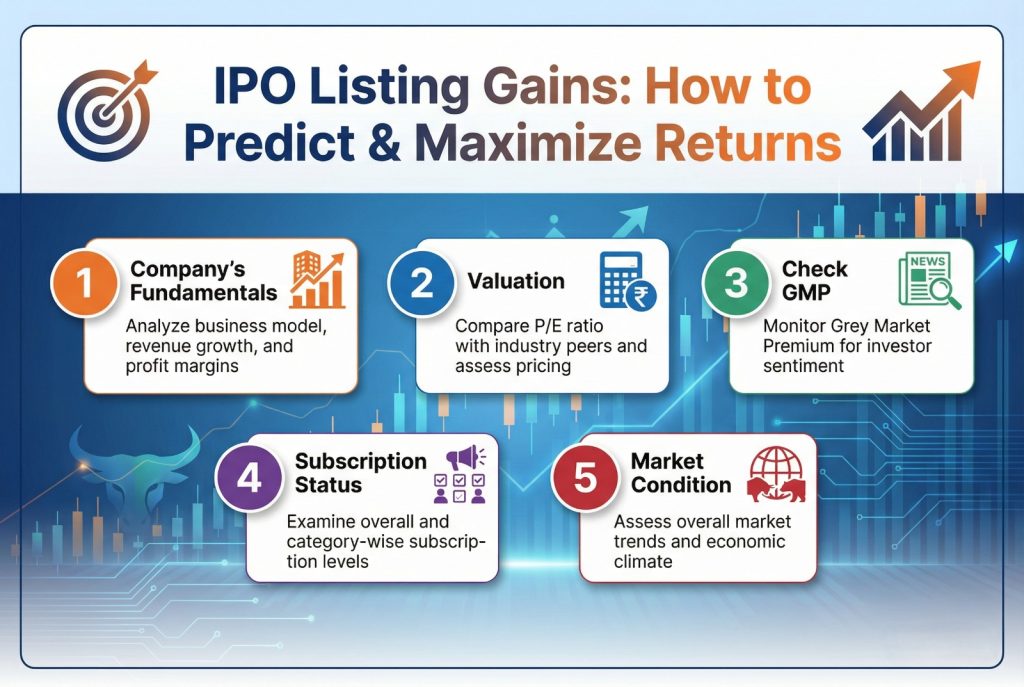
❖ How to Predict IPO Listing Gains
Not every IPO launched in the market, whether a mainboard IPO or an sme IPO, offers listing gains. To receive the higher listing gains, investors must look for a few indicators for successful returns. The following are the key factors investors must keep in mind.
1. Check the company’s fundamentals:
Analyze the company’s RHP/DRHP to review revenue growth, profitability, debt levels, cash flow, margins, and balance sheet strength. A company with strong fundamentals and good financial health will most likely offer high ipo listing gains.
2. Valuation:
We recommend investors analyze the company’s P/E and P/B ratios with its peer competitors and check if the IPO valuation is reasonable to industry standards. The underpriced IPO is most likely to offer listing gains, while the overpriced IPO struggles to offer gains.
3. Check GMP (Grey Market Premium):
Tracking the upcoming IPO GMP today helps investors to understand the demand for the IPO in the grey market. A strong demand for the IPO in the Grey Market indicates that the IPO might offer high listing gains. When a company announces its IPO, the Grey Market, which is an unofficial market, starts to show expecting listing gains.
A high GMP shows that the IPO might offer good listing gains. GMP fluctuates depending on the market sentiment and strong investor demand. However, a high GMP does not always guarantee strong listing gains, so take it only as an indicator.
4. Check Subscription numbers:
Take a look at the subscription numbers of the IPO you applied for. A high demand for the IPO, especially from Qualified Institutional Buyers (QIBs) and High Net Worth Individuals (HNIs), gives a positive sign of listing gains.
5. Market Condition:
Check if the stock market is bullish or bearish. A bullish and strong market suggests high listing gains, while a bearish and weak market may limit returns.
❖ How to Maximize IPO Listing Gains
1. Apply for the quality IPOs
Do not apply for every upcoming IPO in India. Do your own research, analyze the company’s fundamentals, its financials, and profitability before applying. A company with strong fundamentals will tend to offer high IPO listing gains.
2. Decide your Exit Strategy
We recommend that investors determine their exit strategy in advance. Decide whether you want to invest in the IPO solely for listing gains or long-term growth. If your goal is short-term, then sell the shares on the listing day and book the profits. If the goal is long-term, then hold the shares of the company with strong growth prospects.
3. Maximize your Chances:
To increase the likelihood of listing gains, we recommend investing in large companies. A reputable and big company not only attracts more investors but also tends to offer stable listing gains. Another tip is to do multiple IPO applications. If you don’t know, only 1 IPO application per PAN is valid. To increase the chance of more listing gains, apply for the IPO through different PAN cards of your family and friends. Multiple application gives high ipo listing gains.
4. Understand the full story:
We understand that not everyone has the time to do deep research on the IPO. But we recommend investors do at least basic research on the company’s financial performance, valuation, and competitors through DRHP/RHP, to get better insights into the company. GMP also plays a vital role in maximizing returns. A high GMP shows a strong investor demand and positive market sentiment for the company. However, take the grey market with a pinch of salt and don’t rely on it completely.
5. Keep Track
Last but not least, track the IPO news, expert opinions, real-time subscription data, and upcoming IPO GMP today to see whether you can expect the ipo listing gains. Investors can track IPO Watch for real-time updates on GMP, ipo subscription, and ipo review & analysis to make smart decisions.
Frequently Asked Questions
IPO listing gain is a profit that investors make when a company lists its shares at a price higher than the issue price on the NSE and BSE.
Predicting IPO listing gains requires analyzing the company’s fundamentals, investor demand, market sentiment, oversubscription by QIB and NII investors, and the Grey market premium may help to decide whether the IPO will list at a premium or discount.
Absolutely not, not every IPO performs well; some may offer listing gains, while some may list at a discount or even drop after listing. Applying to every IPO without doing an in-depth analysis can put your investment at risk.
Any company with a strong fundamental background, healthy financials, reasonable valuations, and strong future growth potential can be the best IPO for listing gains. Track the IPO Watch to stay updated on upcoming mainboard IPO and Sme IPO in India.