

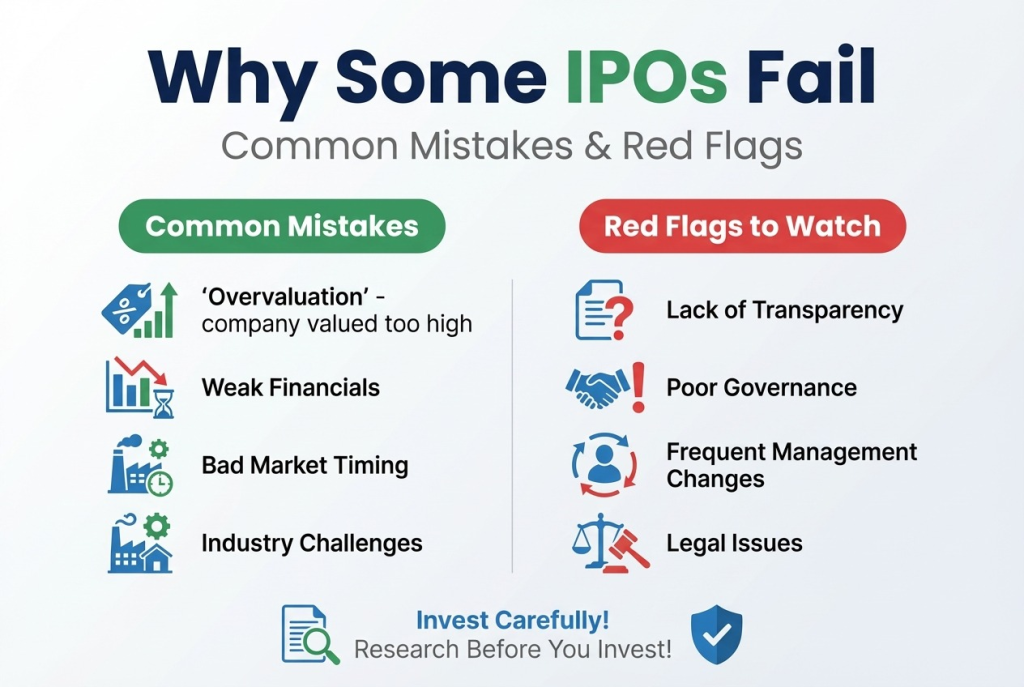
Learn the common mistakes and red flags to avoid for successful IPO investing and to prevent losses.
IPO process
Over the years, investing in Initial Public Offerings (IPO) has increased rapidly as many investors see them as an opportunity to earn quick profits. But do you think every IPO offers good listing gains? While many IPOs do offer guaranteed listing gains, some fail miserably. In the past, several IPOs have disappointed investors, and the same can happen in the future.
IPO investment can be daunting for investors who do not properly understand the IPO process or fail to detect common mistakes or red flags. In this article, we will help you understand these common mistakes and red flags so you can avoid making poor IPO investment decisions.
Common Mistakes & Red Flags to Avoid
- Overvaluation: One of the biggest common mistakes made by the company is setting up the IPO price higher than its justified valuation based on fundamentals. Sometimes, companies trade their shares at a high price compared to what the company is truly worth, which deters investors from investing in the company.
- Weak or inconsistent Financials: Another common mistake investors should watch out for is weak fundamentals and a lack of profitability of the company. Before investing in any ipo, investors must analyze the company’s revenue, profit margins, operating cash flow, and overall valuation for long-term growth potential.
- Excessive debt: Another red flag an investor must keep in mind is a large amount of pending debt by the company. Some companies only plan to raise funds to repay their old debts rather than use the funds towards future growth.
- Poor investor communication: Companies that fail to communicate clearly during the IPO process are often considered a major red flag. The common mistakes made by a company are not expressing their business model, revenue, or strategies for future growth, which can lead to confusion among investors and low interest in the IPO.
- Poor Corporate Governance: Issues like an unstable management team, lack of transparency, few independent directors, inadequate financials & risk controls, or an unclear business strategy lead to high risk for investors.
- Unfavourable market timing: Another common mistake is launching the IPO during market uncertainty, which can lead to low investor interest, low subscription, and low returns.
- Regulatory and Compliance Rules: The biggest red flag is companies that do not meet the strict rules set by the SEBI, such as incomplete financial disclosures, improper stakeholder classification, or lack of transparency in regulatory filings.
- Heavy Dependence on One Product, Client, or Sector: The firm that operates its business through a single or a few products with limited clients and targeting one sector is another red flag.
Here is an example of an IPO that failed to perform due to its common mistakes.
Reliance Power IPO: It was one of the biggest IPO in the year of 2008 and was oversubscribed many times. The share price was set at ₹450 by the company.
However, on the listing day, the price fell sharply by ₹372.50, indicating a 17% loss from the issue price, causing loss for many investors. The reason behind the IPO failure is the overvaluation, weak fundamentals, execution failures, and high debt.