

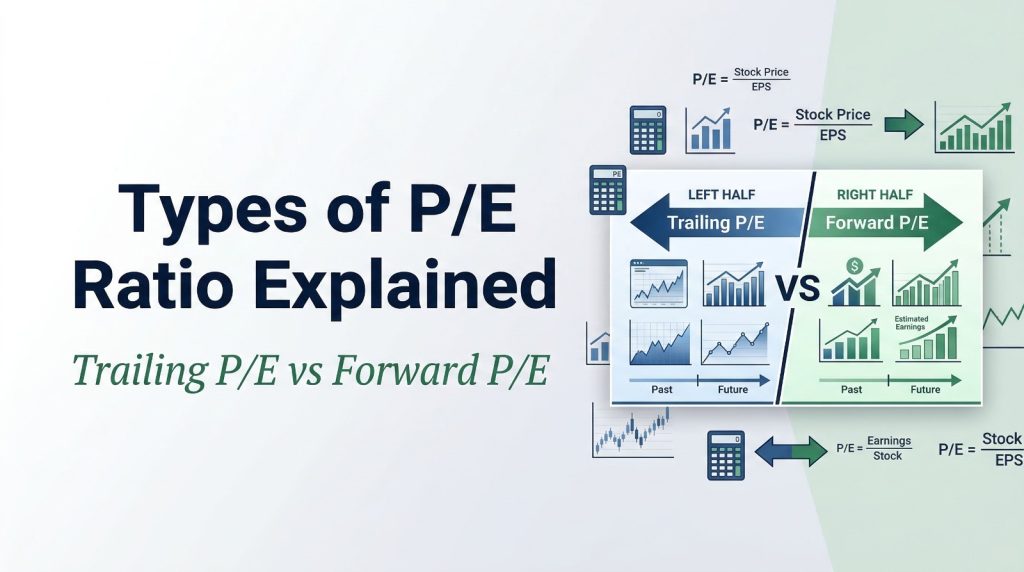
What is the P/E ratio?
The P/E ratio shows how much investors are willing to pay for every ₹1 of a company’s earnings. It helps investors understand whether a stock is expensive or cheap compared to its profits.
Though finding the P/E ratio’s importance is useful for people to know more about a company’s valuation, it assists them in making better decisions.
What are the types of P/E ratios?
1. Absolute P/E ratio
The Absolute P/E Ratio is the current market price of a share divided by the company’s Earnings Per Share (EPS), which can be based on past earnings (Trailing EPS) or expected future earnings (forward EPS).
Formula:
Absolute P/E = Current Share Price ÷ EPS
2. Relative P/E ratio
The relative P/E ratio is the current P/E ratio relative to a benchmark, such as the industry P/E, the market P/E, or the past P/E.
The relative P/E ratio reflects the company’s overall consistency, including past earnings, and whether the stock is overvalued.
If a company’s P/E ratio is 20 and the industry’s P/E ratio is 15, then the company’s stock is considered overvalued.
3. Trailing P/E Ratio
The Trailing P/E Ratio is calculated by dividing the current market price of a share by the company’s earnings per share (EPS) from the past 12 months.
Formula:
Trailing P/E = Current Share Price ÷ EPS (last 12 months)
This ratio is based on actual historical earnings, which makes it more reliable than estimates.
4. Forward P/E Ratio
The Forward P/E Ratio is the price-to-earnings ratio calculated using a company’s expected future earnings instead of past earnings.
Formula:
Forward P/E = Current Share Price ÷ Expected Future EPS
This ratio uses estimated earnings (usually for the next 12 months) based on analysts’ or the company’s growth projections.
Let’s understand step by step the difference between Trailling P/E and Forward P/E.
| Trailing P/E | Forward P/E | |
| Defination | Trailing P/E: Shows how much investors pay for ₹1 of a company’s earnings over the past year. | Forward P/E: Shows how much investors pay for ₹1 of a company’s expected future earnings. |
| Calculation | Trailing P/E is calculated by dividing the current share price by the company’s earnings per share (EPS) over the past 12 months. | Forward P/E is calculated by dividing the current share price by the company’s expected future earnings per share (EPS). |
| Type | Trailing P/E is based on historical performance. | Forward P/E is a forecast of a company’s earnings. |
| Importance | Investors can get more reliable and accurate data on the company. | Investors can receive the estimated profit. |
| Information | It is good for checking the past performance of companies. | It is satisfactory for checking the company’s future earnings planning. |
| Limitation | This can not show future growth. | This can not show realistic data as it is optimistic. |
| Example | A company earned ₹50/share last year, stock price ₹500 → Trailing P/E = 10. | Analysts expect the company to earn ₹60/share next year, stock price ₹500 → Forward P/E ≈ 8.33. |
How to calculate the Trailing P/E ratio and Forward P/E ratio?
1. Trailing P/E Ratio Calculation:
It is based on the company’s past 12 months’ earnings.
Formula:
Trailing P/E = Current Market Price per Share ÷ Earnings per Share (EPS) of last 12 months
Example:
If share price = ₹200
EPS (last 12 months) = ₹20
Trailing P/E = 200 ÷ 20 = ₹10
2. Forward P/E Ratio
It is based on the company’s expected future earnings (next 12 months).
Formula:
Forward P/E = Current Market Price per Share ÷ Expected Future EPS
Example:
If share price = ₹200
ExP/Ected EPS (next year) = ₹25
Forward P/E = 200 ÷ 25 = ₹8
Conclusion
Understanding the IPOs and their P/E ratio can help investors make more informed decisions. By analysing key financial metrics like the P/E ratio, investors can better assess a company’s valuation and growth potential before participating in an IPO. Platforms like IPOWatch provide information on upcoming IPOs, including important metrics such as P/E ratios. This can help investors to understand the companies more precisely and help them to make proper investment decisions.