Steamhouse India IPO Review – Well-Informed/Cash Surplus Investors May Park Moderate Funds for Long Term
Issue Details / Capital History
The company is coming out with its maiden book building route combo IPO worth Rs. 414.00 cr. (approx. 51111111 equity shares at the upper cap). The IPO consists of fresh equity shares worth Rs. 353.00 cr. (approx. 43580247 equity shares at the upper cap) and an Offer for Sale (OFS) worth Rs. 61.00 cr. (approx. 7530864 equity shares at the upper cap). The company has announced a price band of Rs. 77 – Rs. 81, per equity shares of Rs. 2 each. The issue opens for subscription on September 09, 2026, and will close on September 11, 2026. The minimum application to be made is for 185 shares and in multiples thereon, thereafter. Post allotment, shares will be listed on BSE and NSE. The issue constitutes 18.49% of the post-IPO paid-up equity capital. From the net proceeds of the fresh equity issue, the company will utilize Rs. 75.95 cr. for capex on capacity expansion in two phases for infrastructure, Rs. 180.00 cr. for repayment/prepayment of certain borrowings, Rs. 38.17cr.capex on setting up of a new manufacturing facility for steam generation at Dahej, and the rest for general corporate purposes.
The sole Book Running Lead Manager (BRLM) to this issue is Equirus Capital Ltd., while KFin Technologies Ltd. is the registrar to the issue. Equirus Securities Pvt. Ltd. is a syndicate member.
After issuing initial equity shares at par value, the company has issued further equity shares in the price range of Rs. 73.00 – Rs. 200.00 per share (on the basis of Rs. 2 FV), between March 2024, and June 2026. It has also issued bonus shares in the ratio of 4 for 1 in November 2022, 2 for 1 in October 2023. The average cost of acquisition of shares by the promoters/selling stakeholders is Rs. NIL, and Rs. 0.04 per share.
Post-IPO, its current paid-up equity capital of Rs. 46.57 cr. (232826065equity shares) will stand enhanced to Rs. 55.28 cr. (276406312 equity shares). Based on the upper cap of the price band, the company is looking for a market cap of Rs. 2238.89 cr.
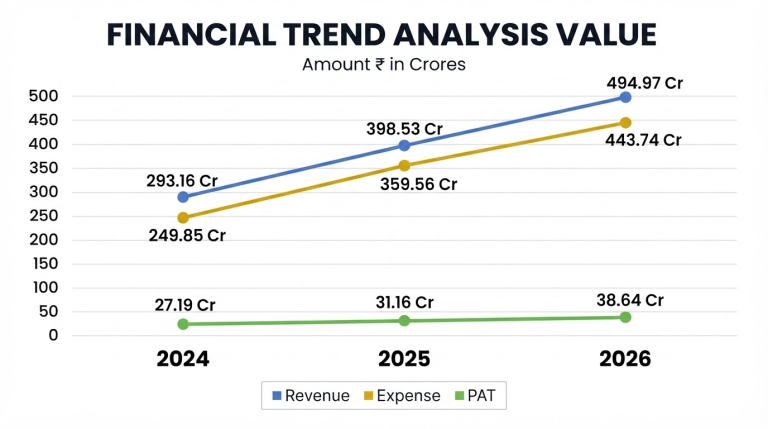
On the financial performance front, for the last three fiscals, the company has posted a total income/net profit, of Rs. 293.16 cr. / Rs. 27.19 cr. (FY24), Rs. 398.53 cr. / Rs. 31.16 cr. (FY25), and Rs. 494.97 cr. / Rs. 38.64 cr. (FY26). The company posted steady growth in its top and bottom lines for the reported periods. Its contingent liability stood at Rs. 82.18 cr. as of March 31, 2026. However, its debt equity ratio of 1.57, and capacity utilization of average 43.3% raise concern.
For the last three fiscals, the company has posted an average EPS of Rs. 1.52 and an average RoNW of 24.14 %. The issue is priced at a P/BV of 11.17 based on its NAV of Rs. 7.25 as of March 31, 2026, and at a P/BV of 13.68 based on its post-IPO NAV of Rs. 5.92 per share at the upper cap.
If we attribute FY26 super earnings to its post-IPO fully diluted paid-up equity capital, then the asking price is at P/E of 57.86. Based on FY25 earnings, the P/E stands at 71.68. The issue appears greedily priced based on its recent average performance.
For the reported periods, the company has reported PAT Margins of 9.27% (FY24), 7.82% (FY25), 7.81% (FY26), and RoCE margins of 20.24%, 17.20%, 16.06%, respectively, for the referred periods.
All amounts in Indian Rupees crores
The company has not paid any dividends for the reported periods of the offer document. It has already adopted a dividend policy in June 2025, based on its financial performance and future prospects.
Comparison with Listed Peers
As per the offer document, the company has shown Linde India, Ellenbarrie Ind. Gases, as its listed peers. They are currently trading at a P/E of 99.3, and 37.7 (as of September 08, 2026). However, they are not truly comparable on an apple-to-apple basis. This comparison appears to be an eyewash. This comparison appears to be an eyewash.
Steamhouse India Ltd. (SIL) is an Indian company specializing in the generation and centralized distribution of industrial gases, including steam and nitrogen, through its pipeline network. It is pioneers of the community boiler system in India, which was first introduced in 2014. (Source: F&S Report). Its community industrial gas generation and distribution systems provide gas to various industrial customers from a pipeline network, which provides an alternative to each individual customer having its own infrastructure.
Having established its steam generation business in India, SIL is now embarking on an expansion plan of supplying other industrial gases. The Company commenced nitrogen production and supply on February 1, 2025.It commissioned first project for nitrogen supply through a pipeline network at Ankleshwar facility, and, in Fiscal 2026 and Fiscal 2025, it generated Rs. 0.58 cr. and Rs. 0.01 cr. revenue from nitrogen operations, respectively. It is the only company in India that supplies nitrogen using a distributed pipeline network instead of the common practice of supplying in cryogenic tanks and onsite nitrogen generation. (Source: F&S Report).
SIL’s industrial gas business consists of • Generation and Distribution of Steam: The generation and distribution of steam through its community boiler system and pipelines, which is its primary business offering, • Purchase and Distribution of Steam: It purchase steam produced by other steam generating entities and distribute it to customers through its pipeline network, and • Separation, Compression and Distribution of Nitrogen: The company extracts nitrogen from atmospheric air by separating it from other atmospheric gases, compressing it and supplying purified nitrogen through its pipeline network.
SIL currently operates seven community steam boilers (six owned and one leased) in Gujarat through which it generates and distributes steam including Vapi Phase 1, Vapi WTE unit, Ankleshwar Phase 1, Ankleshwar Phase 2, Sarigam, Nandesari and Panoli. Its facilities are strategically located near Indian ports and near customer clusters in Gujarat. As of July 31, 2026, its combined installed plant capacity for steam across its seven boilers is an aggregate of 345 tonnes per hour (“TPH”), which translates to an annual installed capacity of 2,185,920.00 tonnes per annum (“TPA”). In addition, the company distributes steam that it purchases in Dahej GIDC (Phase 1) and Sachin GIDC. In April 2026, it entered a steam purchase agreement with a chemical company to purchase and distribute steam for a term of 5 years in the Dahej SEZ as well as a steam purchase agreement with a chemical company to purchase and distribute steam for a term of 5 years in Haldia.
It expects to commence operations in both Dahej SEZ and Haldia in the next 12 months from the date of this RHP. Further, it has one nitrogen generation and distribution facility, which is located in Ankleshwar and commenced commercial operations on February 1, 2025 with a capacity of 350 NM3/hour. The company endeavors to meet the steam requirements of its customers through community boilers by implementing eco-friendly solutions, reducing pollution from several industries and providing cost efficient solutions. Except for its waste fired boilers, all steam boilers have atmospheric fluidized bed combustion (“AFBC”) designs that reduce fuel consumption. These AFBC boilers help reduce the emission of sulphur oxide (“SOx”) and nitrogen oxide (“NOx”), which are major air pollutants. Further, the use of community boilers often results in more efficient and optimized combustion processes as compared to individual boilers. (Source: F&S Report).
As of July 31, 2026, it owned, operated and maintained a 60,151 meters operational pipeline system connecting its facilities to customers’ premises. It has established pipeline rights-of-ways, which are easements granting it the legal right to use land for pipelines, with its pipelines typically connecting to customer-owned pipes on their premises. It has an established industrial customer base in Gujarat, India with reputed clients across key sectors including, pharmaceuticals, chemicals, textiles, agro-chemicals, tyres, dyes and pigments, polymers, paints and other sectors. Selected examples of its customer base include Aether Industries Limited, Anupam Rasayan India Limited, Globe Enviro Care Limited, Gujarat Polysol Chemicals Limited, Devanshi Dyestuff, K. Patel Chemo Pharma Private Limited, K. Patel Dye Chem Industries Private Limited, Mahavir Synthesis Private Limited, Mangalam Intermediaries, Orgo Chem Gujarat Private Limited and Subhasri Pigments Limited. For Fiscal 2026, Fiscal 2025 and Fiscal 2024, its revenues from repeat customers accounted for 90.72%, 88.01% and 91.49% of its revenues from operations, respectively. As of July 31, 2026, it had 229 employees on its payroll and additional 276 contractual workers.
Merchant Banker's Track Record
The sole BRLM associated with this issue has handled 15 IPOs in the last three fiscals and out of which 2 IPOs closed below the issue price on listing date.
Conclusion
SIL specializes in generation and centralized distribution of industrial gases including steam and nitrogen, through its pipeline network. The company marked steady growth in its top and bottom lines for the reported periods. Lower capacity utilization and higher debt remains major concerns. Based on its recent average financial data, the issue appears greedily priced. Considering its unique business that has entry barriers, this company may fetch first mover fancy post listing. However, well-informed/cash surplus investors may park funds for long term.
Dilip Davda is a veteran financial journalist associated with the Indian stock market since 1978. He has been contributing to print and electronic media on capital markets, insurance, and finance since 1985.
He is widely recognized for reviewing public issues and non-convertible debentures (NCDs) in the primary market. Drawing on over three decades of market experience and close interaction with merchant bankers, his reviews focus on detailed fundamental and financial analysis of companies, with a special emphasis on SME public issues.
Disclaimer: The information provided herein is solely for educational and informational purposes and does not constitute an offer, solicitation, or recommendation to buy or sell any securities. Readers are advised to consult a qualified financial advisor before making any investment decisions. Investments in the securities market are subject to market risks. The author does not intend to invest in the securities discussed.