

What is an IPO?
When a company decides to sell its shares to the public for the first time on the stock market, it is known as IPO (Initial Public Offering). An IPO means that a company offers its shares to the public for the first time and invites investors to buy them.
Why does a company announce its IPO?
There are various reasons behind the company’s decision to launch its Initial public offering (IPO). When a company wants to raise funds for its growth and expansion, it may choose to announce its IPO.
Other than that, the company also launched its IPO to repay the debt, enhance brand visibility, and allow investors to exit the company. Usually, most IPO open for 3-day subscription periods, during which investors get a chance to submit their IPO application to the stock exchange and wait for their allotment.
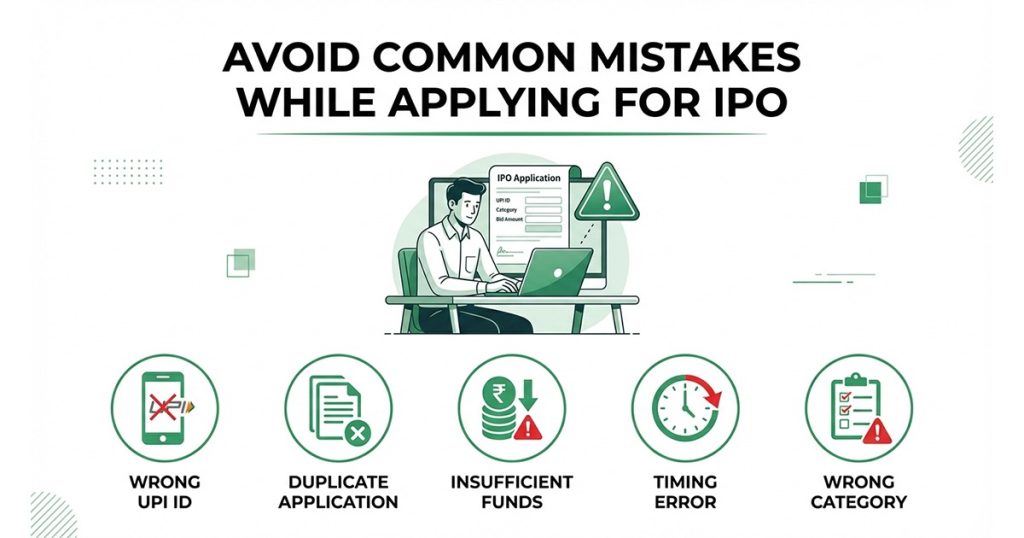
IPO Application Mistakes to Avoid
Have you ever experienced rejection, mandate failures, or missed allotment due to a small mistake you made? Well, not anymore! Planning to apply for the upcoming IPO? Then this guide is for you. This guide will help you understand IPO mistakes to avoid, improving your chances of a successful application.
1. Not having an Adequate Bank balance.
- If you don’t have a sufficient amount needed for an IPO in your bank balance, then your application will not be completed.
- Check your account to have the required funds; otherwise, the funds will not be blocked, and you will miss the chance of getting potential allotment.
2. Approving UPI Mandate
- Investors submit their IPO application, but always forget to approve the UPI mandate.
- Once you submit your IPO application, approve the UPI mandate before its deadline.
- After clicking on Apply for the IPO, within a few minutes, you will be notified with a mandate approval message from your UPI app.
- Kindly click on Authorise within the given time to successfully submit your IPO application.
3. Entering the Wrong UPI ID
- Another IPO common error people make is to enter the wrong UPI ID.
- Ensure that the UPI ID is correct and is linked to your bank account. Double-check the UPI ID before submitting your application.
4. Applying at the last moment
- Most of the IPOs open for a 3-day subscription period. During which you can apply for the IPO on the last day of subscription, but there are chances that your application might not get submitted on the closing day due to technical issues.
- If possible, apply before the last day to avoid IPO mistakes.
5. Using the Same UPI ID for Multiple Applications
- Investors should use only their own UPI ID when applying for an IPO.
- Using someone else’s UPI ID, or allowing others to use your personal UPI ID for their application, can lead to application rejection. So, if possible, use your own UPI ID linked to a bank account.
6. Picking the right investor Category
- Selecting the correct investor category is important when applying for an IPO. Each category, Retail, S-HNI, B-HNI, Employee, or Shareholder, has specific eligibility criteria.
- If you apply under the wrong category, your application will get rejected by the exchange.
- To avoid IPO mistakes, always check the investor category before submitting your application for successful allotment.
7. Ignoring the Error Message
- If you think that the IPO application is successfully submitted, that might not be the case.
- Sometimes, the UPI mandate can fail, or the bank rejects your application, or you might not have sufficient bank balance.
- Once submitting, always check the broker app for application status, check UPI ID for mandate approval, or check mail or SMS for any errors.
8. Applying Based on GMP Alone
- Another IPO mistake people make is not properly checking the company’s background, financials, and only depending on the Grey market can lead to a loss of money.
- Take GMP as an indication; it does not guarantee profit. So, make sure to do the complete analysis on the company before submitting your application.
9. Selecting Relevant Platform
- With so many broker platforms available in the market today, choosing the right one is essential.
- A relevant and trustworthy platform ensures a smooth process and a maximum chance of getting an allotment.