

Jio entered the telecom market in 2016 with free internet, high-speed mobile broadband, and voice calls, making other telecom companies more competitive. This move gave people affordable, accessible internet connectivity, allowing them to switch to 4G services and sparking a major surge in data usage.
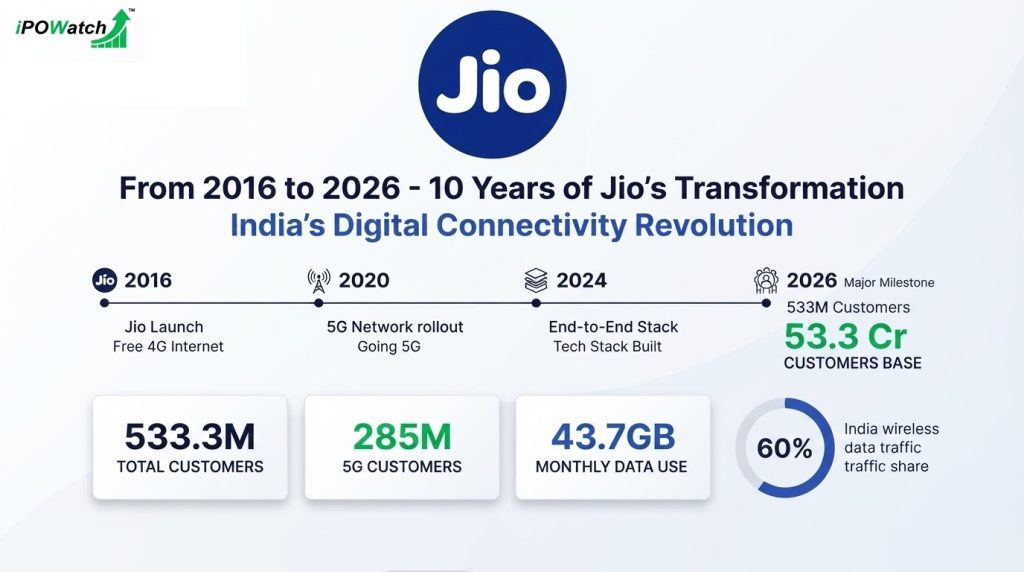
Over the past 10 years, Jio has grown from providing digital connectivity to being the only global company with a proprietary end-to-end connectivity stack, home broadband, entertainment, cloud services, Artificial Intelligence (AI), and other solutions.
Where does Jio stand now? Its extraordinary execution and ability to scale transformed the concept of mobile connectivity, earning it a customer base of 533.3 Mn (53.3 crore) customers and 285 Mn 5G customers as of June 30, 2026, making it both the largest digital connectivity player and the largest 5G customer base outside China.
According to Jio’s RHP, in FY26, 60% of India’s wireless data traffic goes through the Jio network, while Jio’s wireless broadband reaches more than 99% of India’s population. Moreover, as of Q1 FY27, Jio’s monthly data consumption is 43.7 GB per customer.
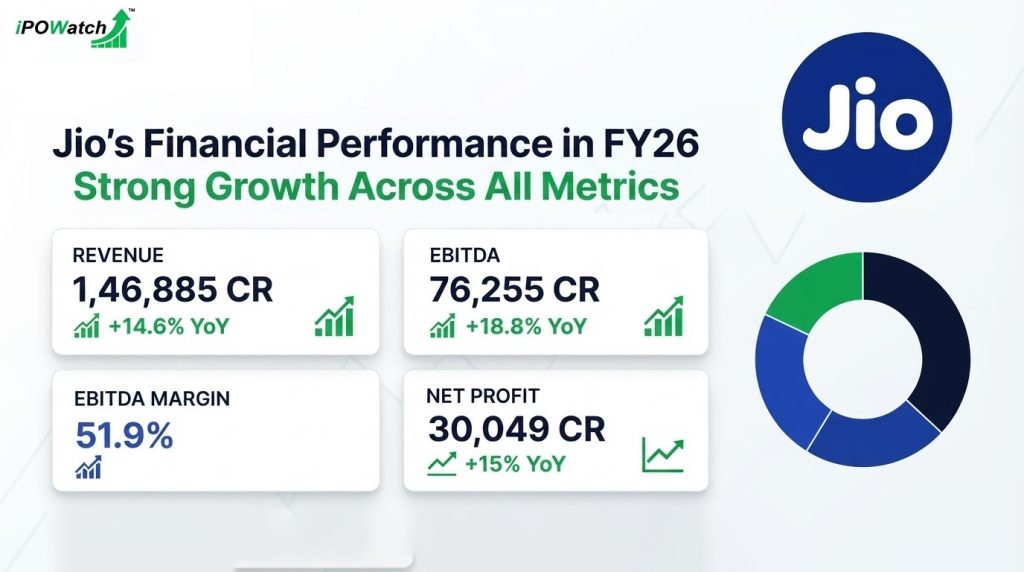
Jio Platforms’ Financial Performance in FY26:
- Revenue: ₹1,46,885 crore, up 14.6% year-on-year.
- EBITDA: ₹76,255 crore, growing 18.8% year-on-year.
- EBITDA Margin: 51.9%.
- Net Profit: ₹30,049 crore, up 15% year-on-year.
What’s next for Jio? Jio has already earned the trust of millions of users and can now generate more revenue from its large customer base. About 261 million of the users in India are still using 2G networks. Jio aims to move those 2G users to 4G and 5G, and expanding fixed broadband can increase data consumption and help it earn more revenue. Jio is not only giving broadband internet but offering a unique lifetime digital experience to its customer base.
Jio has also grown in its entertainment business by launching Jio TV and Jio TV+, giving users access to more than 1,000 digital TV channels and 15 OTT services. The company also partnered with the JOJO app, a Gujarati-language entertainment platform, to launch JioFastTV.
“The RIL Group, after Jio’s listing, will be India’s largest conglomerate by listed market cap,” – said Kotak Mahindra Bank founder Uday Kotak at the Jio Platforms IPO press conference on October 15.
“Jio’s mission is to connect every Indian household, citizen, and enterprise with the highest-quality and most affordable digital services,” – said Akash Ambani.
They have built an end-to-end technology stack that spans 4 areas: network infrastructure, digital services, fully integrated home platforms, and digital applications.
Akash Ambani also said Jio delivers the highest quality of services to its customers, giving an average download speed of 200 Mbps. Moreover, Jio’s pricing is 4.9 per GB, the lowest compared to the other operators.
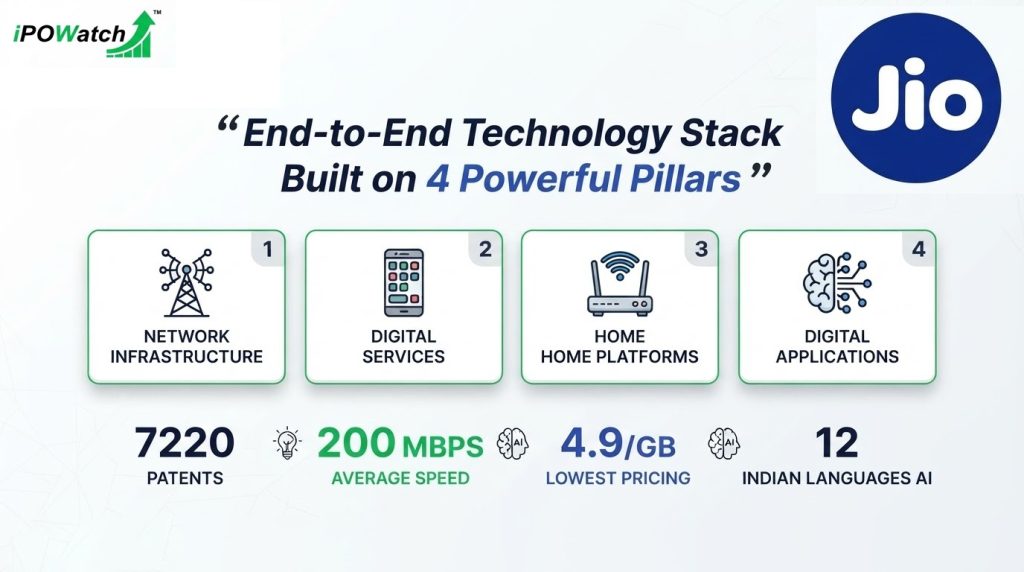
Furthermore, Jio is the 20th-largest global company and has filed 7,220 patent applications as of March 31, 2026. They also launched AI-powered voice tracking, which can transcribe and summarise speech across 12 Indian languages.
Out of the total issue price, Jio is expected to use the funds of ₹27,500 crore towards repayment of the existing borrowings taken by Reliance Jio Infocomm and aims to make the business debt-free.
Jio Platforms IPO may attract both short-term and long-term investors. Short-term investors may look for listing gains, while long-term investors can benefit from Jio’s strong customer base, expanding digital services, and future growth opportunities.
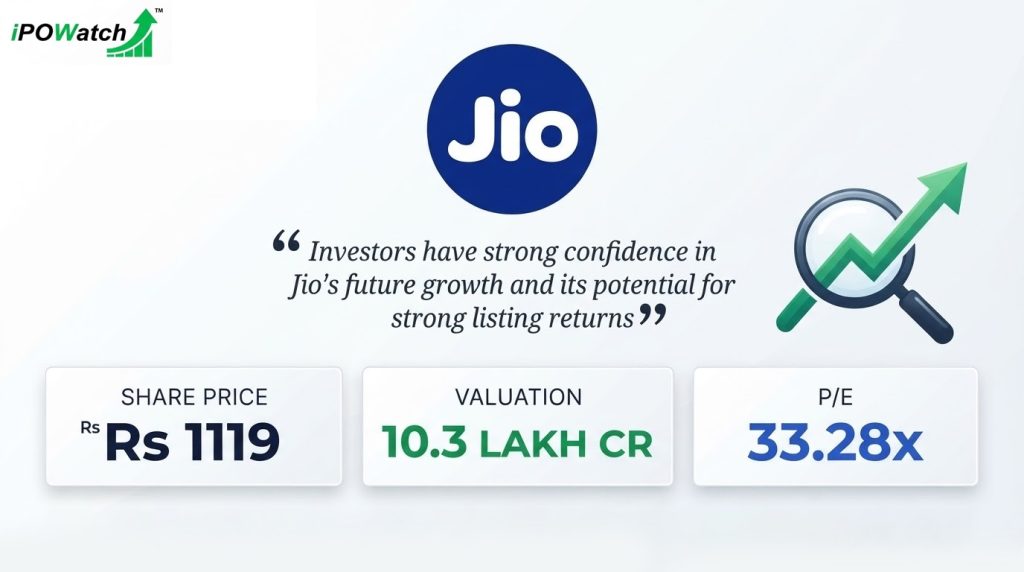
Investors have high expectations from Jio Platforms with its expected listing gain. Will it be able to meet the expectations of investors? At the upper price band of ₹1,119 per share, Jio is seeking a valuation of ₹10.3 lakh crore at a P/E of 33.28x. The valuation may seem on the premium side, but investors may be attracted by Jio’s strong network infrastructure, growing customer base, and high potential for consistent growth.