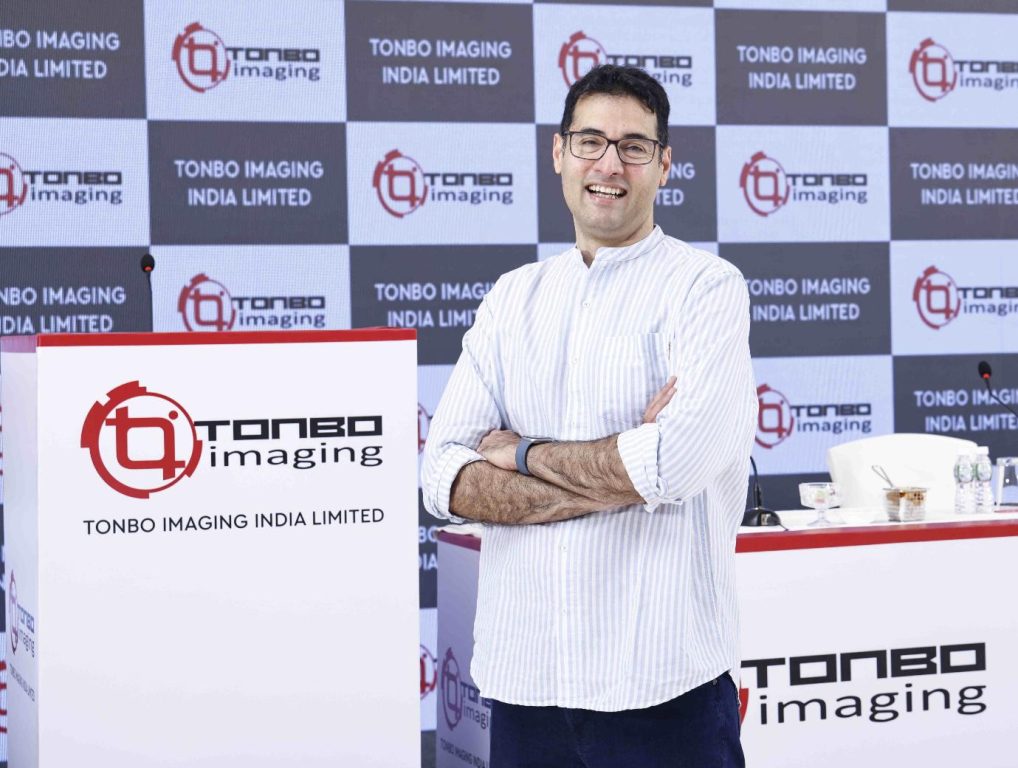
Tonbo Imaging IPO Review by Dilip Davda
Issue Details / Capital History
The company is coming out with its maiden book building route secondary IPO of 12174046 equity shares worth Rs. 852.18 cr. at the upper cap. The company has announced a price band of Rs. 665– Rs. 700 per equity shares of Rs. 2 each. The issue opens for subscription on October 15, 2026, and will close on October 19, 2026. The minimum application to be made is for 21 shares and in multiples thereon, thereafter. Post allotment, shares will be listed on BSE and NSE. The issue constitutes 21.25% of the post-IPO paid-up equity capital. This being a pure Offer for Sale (OFS), no funds are going to company. The issue is being made to provide exit to some of its stakeholders, and unlock the listing benefits.
The company has reserved 14000 equity shares (worth Rs. 0.98 cr. at the upper cap) for its eligible employees, and from the rest, it has allocated not more than 50% for QIBs, not less than 15% for HNIs, and not less than 35% for Retail investors.
The joint Book Running Lead Managers (BRLMs) to this issue are JM Financial Ltd., and IIFL Capital Services Ltd., while KFin Technologies Ltd. is the registrar to the issue.
Having issued initial equity shares at par value, the company has issued further equity shares in the price range of Rs. 36.60 – Rs. 5000.00 per share, (based on Rs. 2 FV), between June 2011, and March 2025. It has also issued bonus shares in the ratio of 9 for 1 in July 2008, 19 for 1 in June 2025. The average cost of acquisition of shares by the promoters/selling stakeholders is Rs. NIL, Rs. Negligible, Rs. 0.27, Rs. 33.91, Rs. 147.15, Rs. 147.19, Rs. 169.81, Rs. 169.88, Rs. 172.73, and Rs. 197.06 per share.
Post-IPO, its current paid-up equity capital of Rs. 11.46 cr. (57282100 equity shares) will stand same as this is a hundred percent secondary issue. Based on the upper cap of the price band, the company is looking for a market cap of Rs. 4009.75 cr.
On the financial performance front, for the last three fiscals, the company has posted a total income/net profit, of Rs. 431.90 cr. / Rs. 68.54 cr. (FY24), Rs. 474.39 cr. / Rs. 72.76 cr. (FY25), and Rs. 369.94 cr. / Rs. 50.88 cr. (FY26). For Q1 of FY27 ended on June 30, 2026, it marked a loss of Rs. – (17.74) cr. on a total income of Rs. 37.32 r. The company posted growth in its performances for the FY24 and FY25, but marked de-growth for FY26 and it was further down for Q1-FY27. Its trade receivables of Rs. 96.85 cr. for Q1-FY27 raise alarm. Its contingent liabilities stood at Rs. 173.20 cr. as of June 30, 2026 raising concern.
For the last three fiscals, the company has posted an average EPS of Rs. 19.49 (basic) and an average RoNW of 20.40 %. The issue is priced at a P/BV of 7.45 based on its NAV of Rs. 94.01 as of June 30, 2026, as well as on the basis of post-IPO NAV per share at the upper cap.
If we attribute FY27 annualized earnings to its post-IPO fully diluted paid-up equity capital, then the asking price is at a negative P/E. Based on FY26 earnings, the P/E stands at 78.83. The issue appears exorbitantly priced based on its recent average performance.
For the reported periods, the company has reported PAT Margins of 15.87% (FY24), 15.34% (FY25), 13.75% (FY26), - (47.52) % (Q1-FY27), and RoCE margins of 67.76%, 27.41%, 14.54%, - (4.31) %, respectively, for the referred periods.
The company has not declared any dividends for the reported periods of the offer document. It has adopted a dividend policy in October 2025, based on its earnings and future prospects.
Comparison with Listed Peers
As per the offer document, the company has shown Paras Defence, Data Patterns, Astra Microwave, Zen Technologies, Bharat Electronics, as its listed peers. They are currently trading at a P/E of 112.0, 85.7, 84.2, 82.1, and 45.2 (as of October 13, 2026). However, they are not truly comparable on an apple-to-apple basis. This comparison appears to be an eyewash.

Tonbo Imaging India Ltd. (TIIL) is a global defence electronics original equipment manufacturer (“OEM”). It designs, develops and manufactures sensing, processing, communication and guidance systems for surveillance, reconnaissance, targeting, and control. It has developed a diversified product portfolio including thermal imaging cores, weapon sights, hand-held thermal imaging binoculars, targeting systems, missile seekers, fire control systems, missile guidance systems amongst others to enable autonomy on the battlefield.
Its expertise spans design capabilities across electro optics and infrared systems (“EO/IR”) and embedded vision systems serving both – Indian and global companies. As per the F&S Report, over the period of April 2024 to March 2026, the Company is the largest manufacturer, in terms of sales value, of thermal imaging systems to government and defence agencies in India. In addition, Company’s market share of thermal imaging exports from India was 94% in terms of units, positioning it as the largest exporter of thermal imaging systems from India by units shipped between FY24 and FY26. With over 28,000 systems deployed across 24 countries, as of June 30, 2026, it is a recognized OEM providing a diverse suite of field-proven electro-optic products free from export restrictions under International Traffic in Arms Regulations (“ITAR”). ITAR is a U.S. export control framework governing the sale, transfer, and sharing of defence related technology, data, and services.
Its EO/IR portfolio is free from ITAR, enabling it to serve non-aligned and export sensitive markets more flexibly, as it designs and develops products within India, making it one of the few global OEMs capable of supplying cutting-edge technologies without geopolitical export limitations. As per the F&S Report, the Company is one of the few companies in India with no dependence on external technology partners as it owns 100% of its intellectual property since Fiscal 2024, pursuant to assignment agreements dated March 11, 2024 through which the Company purchased intellectual property from CEAQ Singapore. The proprietary technology ranges from optics to embedded software and electronics. The Government of India has introduced numerous policies under the ‘Make in India’ initiative and the ‘Atmanirbhar’ vision, introducing reforms to promote the indigenous design, development and manufacturing of defence equipment in the country, thereby reducing reliance on defence imports.
Introduced in 2020, India’s Defence Acquisition Procedure 2020 (“DAP 2020”), “Indigenously-Designed, Developed and Manufactured” (“IDDM”) is a part of India’s ‘Make in India’ initiative for defence. In order to be an eligible IDDM vendor under the DAP 2020, it is required to ensure that the control of the Company is with Indian citizens and at least half of the ex-factory cost of the products needs to originate from Indian design, development, production or value-addition, and limits the permissible foreign or non-indigenous content in the final product to a maximum of 50% of the overall contract value.
TIIL is a supplier under IDDM. It was incorporated in 2003 as a subsidiary of a research company initially providing R&D and technology development services focused on designing intellectual property. In 2012, post the buyout of the erstwhile subsidiary of the research company by its Promoters, TIIL transitioned into a defense-focused product manufacturing company, developing and supplying advanced electro-optic and electronic systems. With over 28,000 systems deployed across 24 countries as of June 30, 2026, the Company offers a diverse suite of field - proven electro-optical solutions. Field-proven denotes systems that have been operationally validated in live combat and security environments, demonstrating reliability, durability, and mission effectiveness under real world conditions. As of June30, 2026, it had 339 employees on its payroll.
Merchant Banker's Track Record
The two BRLMs associated with this issue have handled 97 public issues in the past three fiscals, out of which 29 issues closed below the offer price on listing date.
Conclusion
TIIL is a global defence electronics original equipment manufacturer. Over the period, it increased its overall product portfolio to meet requirements by the defence sector. The company is operating in a highly competitive and fragmented segment. The company posted erratic and inconsistent financial performance. It posted dismal performance for Q1-FY27, that remains major concern. Based on its recent average financial performance, the issue appears exorbitantly priced. Only well-informed/cash surplus investors may park moderate funds for long term.
Dilip Davda is a veteran financial journalist associated with the Indian stock market since 1978. He has been contributing to print and electronic media on capital markets, insurance, and finance since 1985.
He is widely recognized for reviewing public issues and non-convertible debentures (NCDs) in the primary market. Drawing on over three decades of market experience and close interaction with merchant bankers, his reviews focus on detailed fundamental and financial analysis of companies, with a special emphasis on SME public issues.
Disclaimer: The information provided herein is solely for educational and informational purposes and does not constitute an offer, solicitation, or recommendation to buy or sell any securities. Readers are advised to consult a qualified financial advisor before making any investment decisions. Investments in the securities market are subject to market risks. The author does not intend to invest in the securities discussed.