LEAP India IPO Review
Leap India Ltd. (LIL) is utilizing its ‘share and reuse’ business model, referred to as pooling, it is the largest on-demand asset pooling provider in India’s supply chain management sector (based on the number of pooled Assets), according to the F&S Report. As of March 31, 2026, it had 14.70 million Assets1 and the company maintains a pan-India network of over 10,100 customer touchpoints. This circular business model supports customers while reducing environmental impact and enhancing the time and cost efficiency and safety of supply chains for customers across India. As of March 31, 2026, LIL had more than 1,000 customers. The nature of its solutions and integration of these solutions into customers’ operations drive their dependence on it, loyalty and retention for the company, with a majority of its top 10 customers (in terms of revenue contribution in Fiscal 2026) having been with it for more than five years.
India’s pallet industry is relatively young, gaining momentum and structure over the past 15 years. India’s logistics sector is characterized by low productivity, largely due to fragmented supply chains, manual handling and inefficient transportation systems, leading to high costs. These challenges are prompting companies in India to seek modern solutions, with supply chain automation becoming increasingly attractive and palletization emerging as a strong element in this transformation.
The pallet pooling market globally is highly consolidated in developed countries, with only a few dominant players. This limited competition often results in standardized practices, high-quality service, and the ability to invest in research and development for further automation and efficiency improvements. Globally, this industry is typically characterized as a monopoly or duopoly within individual countries.
LIL consolidated its position in the asset pooling industry by acquiring CHEP India in January 2025. According to the F&S Report, CHEP India was a leading provider of pallet and container pooling services, backed by a long track record, best practices, and strong customer relationships and was also recognized as the market leader in asset pooling in the container segment in Fiscal 2024. With the addition of CHEP India’s established asset pooling network with its own, the company has expanded its network reach across various industries, enhanced its ability to serve a broader customer base and increased product portfolio, in particular in relation to its container business.
Product quality is core to LIL’s value proposition. The company uses Forest Stewardship Council (“FSC”) certified spruce-pine-fir (“SPF”). Further, it runs repair and maintenance programs and follow quality standards in an effort to extend asset lifespan and establish its commitment to environmental responsibility. The company also provides internal quality certifications for pallets which are deployed to its customers. The company leverages technology to deliver its solutions to customers. Its in-house developed MyLEAP platform provides customers with an interface which highlights order information for tracking and management, details of recent orders, options for swapping damaged Assets, reports, as well as offering options for help and support. LIL has integrated SAP S/4HANA and Salesforce Management into systems, enabling electronic data interchange with customers.
For tracking capabilities, it utilizes passive RFID technology, allowing for monitoring of containers throughout the supply chain. For its MHEs, it has implemented IoT or passive RFID solutions in forklifts, enabling tracking of forklift movements at customer locations which helps with better navigation of equipment and enhanced safety. Additionally, it has developed a suite of in-house mobile and web applications, including the RFID App, Asset Audit App, Transport Management System and Proof of Delivery (“POD”) App, each designed to address requirements such as asset verification, inventory management, and proof of delivery.
The company is dedicated to building an efficient supply chain by directly addressing the key challenges faced by customers. It ensures timely delivery and product quality, which are pillars of effective supply chain management. LIL’s pooling solutions enable customers to operate through an asset-light model, where they can hire and de-hire Assets saving capital expenditure that could be reinvested into their primary businesses. This allows customers to avoid the upfront procurement costs and follow on maintenance expenses associated with owning pallets, containers, and MHEs. Its pooling model provides customers with access to a large, standardized pool of pallets and containers. Standardization ensures compatibility with automated and mechanized supply chain processes, reduces the risk of product damage, and supports efficient stacking and storage in warehouses. Customers benefit from consistent asset quality and availability, supporting smoother operations and more reliable supply chain performance.
Further, maintenance and repairs are handled by LIL’s quality and repairs team, reducing downtime and making asset management easier for customers. Its model is also flexible, and customers can scale pallet volumes up or down on-demand, to match their requirements. Additionally, it collaborates with customers and analyses and provides optimized solutions which are designed to meet customers’ requirements. For transportation providers, its solutions streamline shipping and stacking, enabling faster vehicle turnaround with reduced loading and unloading times, and improving overall handling efficiency by reducing manual handling. For distributors, its solutions focus on worker safety, minimizing product damage, increasing handling efficiency, and reducing double handling, especially with movement hire. Further, its technical team works closely with customers to understand their challenges and deliver solutions. This consultative approach ensures that each customer receives a solution optimized for their operational needs.
Its customer list features organizations such as Hindustan Coca-Cola Beverages Private Limited, Marico Limited, Toll (India) Logistics Private Limited, Daikin Airconditioning India Private Limited, Panasonic Life Solutions India Private Limited, Haier Appliances India Private Limited, Daimler India Commercial Vehicles Private Limited, Autoliv India Private Limited and Sanathan Textiles Limited, among others. This coverage across sectors is a testament to its ability to meet the varied and complex requirements of large customers. Serving such marquee customer base not only enhances its reputation in the market but also provides it with valuable insights into evolving industry needs, enabling the company to continuously refine and expand its offerings. LIL’s customer base is both diverse and expanding, as evidenced by the growth in its total number of customers to over 1,000 customers as of March 31, 2026 from over 500 customers as of March 31, 2024. As of March 31, 2026, it had overall 2481 employees on its roll (including 2062 MHE operators.

Issue Details / Capital History
The company is coming out with its maiden book building route combo IPO worth Rs. 2480 cr. (approx. 155974843 equity shares at the upper cap). The IPO consists of fresh equity shares worth Rs. 480.00 cr. (approx. 30188679 equity shares) and an Offer for Sale (OFS) worth Rs. 2000.00 cr. (of approx. 125786164 equity shares at the upper cap). The company has announced a price band of Rs. 151 – Rs. 159 per equity shares of Re. 1 each. The issue opens for subscription on August 07, 2026, and will close on August 11, 2026. The minimum application to be made is for 91 shares and in multiples thereon, thereafter. Post allotment, shares will be listed on BSE and NSE. The issue constitutes 35.41% of the post-IPO paid-up equity capital. From the net proceeds of the fresh equity issue, the company will utilize Rs. 360.00 cr. for repayment/prepayment of certain borrowings, and the rest for general corporate purposes.
The company has reserved equity shares worth Rs. 1.25 cr. (approx. 78616 equity shares at the upper cap), and from the rest, it has allocated not more than 50% for QIBs, not less than 15% for HNIs and not less than 35% for Retail investors.
The four Book Running Lead Managers (BRLMs) to this issue are JM Financial Ltd., Avendus Capital Pvt. Ltd., IIFL Capital Services Ltd., and UBS Securities India Pvt. Ltd., while MUFG Intime India Pvt. Ltd. is the registrar to the issue. JM Financial Services Ltd., and Spark Institutional Equities Pvt. Ltd. are syndicate members.
After issuing initial equity shares at par value, the company has issued further equity shares in the price range of Rs. 40.88, - Rs. 400.00 (on the basis of Re. 1 FV) between December 2014, and July 2026. It has also issued bonus shares in the ratio of 19 for 1 in March 2022, and 3 for 1 in August 2025. The average cost of acquisition of shares by the promoters/selling stakeholders is Rs. NIL per share.
Post-IPO, its current paid-up equity capital of Rs. 41.03 cr. will stand enhanced to Rs. 44.05 cr. Based on the upper cap of the price band, the company is looking for a market cap of Rs. 7004.53 cr.
IPO Lead Managers & Registrar
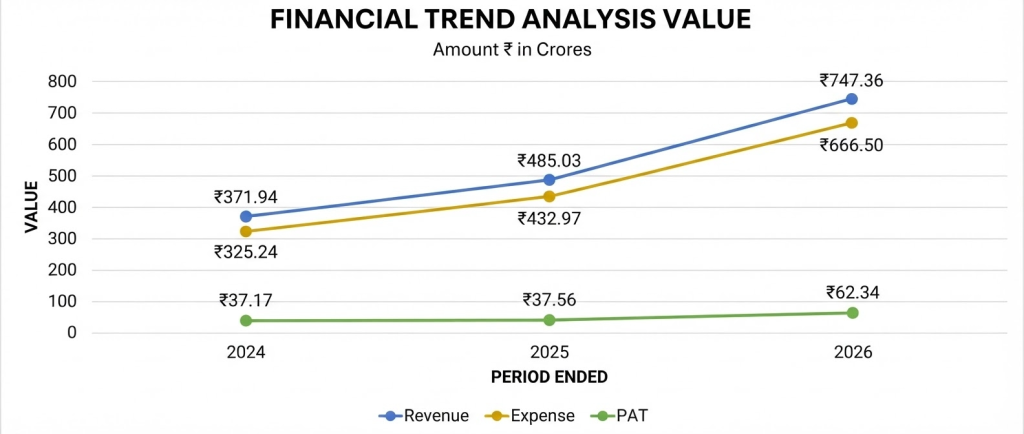
On the financial performance front, for the last three fiscals, the company has (on a consolidated basis) posted a total income/net profit of Rs. 371.94 cr. / Rs. 37.17 cr. (FY24), Rs. 485.03 cr. / Rs. 37.56 cr. (FY25), and Rs. 747.36 cr. / Rs. 62.34 cr. (FY26). The company posted growth in its top and bottom lines for the reported periods. Its contingent liability stood at Rs. 7.74 cr. as of March 31, 2026.
According to the management, growing economy and rising logistics need has turned in favor of the company and based on its recent trends and the business prospects ahead, it is poised for a speedy growth. It virtually enjoys virtual monopoly in the segment and is emerging as a global player.
For the last three fiscals, the company has posted an average EPS of Rs. 1.27 (basic) and an average RoNW of 5.33 %. The issue is priced at a P/BV of 6.48 based on its NAV of Rs. 24.52 as of March 31, 2026, and at a P/BV of 4.71 based on its post-IPO NAV of Rs. 33.74 per share at the upper cap.
If we attribute FY26 super earnings to its post-IPO fully diluted paid-up equity capital, then the asking price is at P/E of 111.97. Based on FY25 earnings, the P/E stands at 187.06. The issue appears exorbitantly priced.
For the reported periods, the company has posted PAT margins of 9.99% (FY24), 7.74% (FY25), 8.34% (FY26), and RoCE margins of 20.33%, 18.01%, 19.06% respectively for the referred periods.
All amounts in Indian Rupees crores
The company has not paid any dividends for the reported periods of the offer document. It has already adopted a dividend policy in August 2025, based on its financial performance and future prospects.
Comparison with Listed Peers
As per the offer document, the company has no listed peers to compare with.
Merchant Banker's Track Record
The four BRLMs associated with this issue has handled 77 IPOs in the last three fiscals out of which 25 issues closed below the issue price on the listing date.
Conclusion
LIL is engaged in the asset pooling services in India’s supply chain management segment. Its customer based doubled in the last three fiscals to mark 1000 customers. The company serves marquee customer base in various segments. The company posted improved top and bottom lines for the reported periods. Based on its recent financial data, the issue appears exorbitantly priced. The company is extracting higher premium for its IPO following its virtual monopolistic business model. Post listing, it may fetch first mover fancy. Only well-informed/cash surplus/risk seekers may park funds for long term, others may stay away.
Dilip Davda is a veteran financial journalist associated with the Indian stock market since 1978. He has been contributing to print and electronic media on capital markets, insurance, and finance since 1985.
He is widely recognized for reviewing public issues and non-convertible debentures (NCDs) in the primary market. Drawing on over three decades of market experience and close interaction with merchant bankers, his reviews focus on detailed fundamental and financial analysis of companies, with a special emphasis on SME public issues.
Disclaimer: The information provided herein is solely for educational and informational purposes and does not constitute an offer, solicitation, or recommendation to buy or sell any securities. Readers are advised to consult a qualified financial advisor before making any investment decisions. Investments in the securities market are subject to market risks. The author does not intend to invest in the securities discussed.