Fusion Klassroom IPO Review (BSE SME)
Fusion Klassroom Edutech Ltd. (FKEL) is operating a scalable, hybrid learning ecosystem comprising 30 offline partner centres, an AI-powered Education OTT App featuring 100+ courses, and a nationwide footprint of over 600K+ registered users with 2 lakhs+ subscribers and 1 lakh+ mobile app downloads. FKEL has executed educational and skilling initiatives, including its MoU with the Government of Rajasthan, implementations across PM Shri Schools and Jawahar Navodaya Vidyalaya (JNV), the RSLDC project, and the Uttar Pradesh girl-child digital education initiative impacting over 1,000 beneficiaries. The Company continues collaborations with national and state missions, universities, skill councils, and institutional partners. Key alliances include NSDC, TSSC, MSSDS, and integrations with state skilling platforms.
The company commenced operations in 2016 with a hybrid tutoring model combining offline academic coaching and technology-enabled delivery. In its initial year, the Company partnered with three coaching centres catering to students from Grades 6–12 and aspirants preparing for JEE/NEET examinations. During this period, the Company provided partner centres with technology support, marketing assistance, and student demand generation.
Between 2017 and 2020, the Company expanded to over 20 learning centres and introduced initiatives such as the “How to Study” workshop and the Klassroom Konnect platform. During this period, the Company maintained an annual learner base of over 500 enrolments. During 2020–2021, the Company expanded its digital operations and launched the Klassroom Online Academy, which included live tutoring, recorded content, tests, assessments, digital notes, examinations, and doubt-solving through digital channels. This enabled the Company to reach over 10,000 registered users with more than 1,500 enrolments across India.
During 2021–2022, the Company continued its online tutoring operations. Registered users increased to over 30,000, with more than 3,000 enrolments. The Company raised funding from investors during this period. The Company also received recognition through interactions with the Hon’ble Prime Minister of India and participation as a finalist in the National Startup Awards. The Company recorded year-on-year growth in its financial performance. In 2022–2023, Klassroom leveraged its digital success to accelerate its B2B and government partnerships. The Company executed 10+ PM Shri School projects and Jawahar Navodaya Vidyalaya (JNV) signed a major MoU with the Government of Rajasthan for academic interventions. As offline learning demand resurged following the pandemic, Klassroom benefited from its early investments in hybrid capability, enabling seamless transition between offline and online. The Company also established a dedicated B2B distribution network and strengthened its position as a trusted government partner for educational transformation.
The period 2023–2024 represented a phase of operational consolidation, hybrid expansion, and large-scale implementation. The Government of Rajasthan initiatives moved into full execution, while the Company expanded its B2B distribution through NGOs, trusts, and institutional partners. Klassroom executed a 1,000+ girl-child digital education project in Uttar Pradesh, reinforcing its commitment to social impact. In 2024–2025, Klassroom entered a new phase with the launch of AI-powered Education OTT App, offering 50+ academic, competitive exam, and skill development courses of 2500 hrs of recorded content. Learner engagement scaled rapidly, surpassing 3 lakhs+ registered users and 50,000 subscribers, supported by a growing base of 25+ offline centres and stable online recorded-course revenue streams. The Company secured a new RSLDC government project benefiting lakhs of learners, further strengthening its national skilling footprint.
By 2025–2026, Klassroom established a strong presence in AI/ML education infrastructure and skill development. The Company partnered with NSDC, TSSC, and MSSDS for national AI/ML training rollouts and established AI/ML Labs across Maharashtra. It collaborated for AI/ML internship programs and integrated its training solutions with Maharashtra Skilling Apps, while also engaging with Tripura SCERT for academic and digital learning initiatives. The Company expanded to 30 offline centres, and its cumulative learner base crossed 6 lakhs+ users, reflecting strong national scale and adoption.
FKEL is Training students and learners to master academics, upskill, and transform their future through a hybrid ecosystem of an AI-powered Education OTT App and offline centers, partner institutions, universities, and government bodies — driving India’s nation-building mission through education and employability. Also operating in India’s rapidly transforming digital-learning ecosystem. Built on the foundational belief that quality education must be accessible, affordable, and employability-driven, the business provides end-to-end academic, vocational, professional, and skill-based education through multiple channels, formats, and delivery mechanisms, enabling lakhs of learners from diverse socio-economic backgrounds to access structured learning opportunities.
Its operations span the full spectrum of India’s education value chain, starting with foundational school education and extending to test preparation, skill development, technology-driven upskilling, AI-ML training programs, professional readiness, and employability enhancement. This continuum of learning is supported by the Company’s proprietary AI-powered OTT architecture that facilitates content delivery, multiple language learning, performance tracking, learner analytics, and multi-format instruction across recorded courses, live classes, assessments, and personalized learning pathways. As of the date of filing this offer document, it had 26 employees on its payroll (including 4 contractual employees).

Issue Details / Capital History
The company is coming out with its maiden book building route combo IPO of 2455200 equity shares of Rs. 10 each to mobilize Rs. 39.04 cr. The issue consists of 1989400 fresh equity issue (worth Rs. 31.63 cr. at the upper cap), and an Offer for Sale (OFS) of 465800 equity shares (worth Rs. 7.41 cr. at the upper cap). The company has announced the price band of Rs. 151 – Rs. 159 per share. The minimum application to be made is for 1600 shares and in multiples of 800 shares thereon, thereafter. The issue opens for subscription on July 31, 2026 and will close on August 04, 2026. The shares will be listed on BSE SME. The IPO constitute 26.35% of the post-IPO paid-up capital of the company. From the net proceeds, the company will utilize Rs. 6.71 cr. for spending on technology and AI/ML model development, servers and cloud infra, Rs. 5.35 cr. for capex on content development, Rs. 1.95 cr. for capex on procurement of desktop, laptop, for new offline centers, Rs. 5.22 cr. for marketing initiatives, Rs. 2.36 cr. for repayment/prepayment of certain borrowings, and the rest for general corporate purposes.
The IPO is solely lead managed by Narnolia Financial Services Pvt. Ltd., and Maashitla Securities Pvt. Ltd. is the registrar to the issue. Pune E–Stock Broking Ltd., is the market maker.
After issuing initial equity capital at par value, the company issued/converted further equity shares in the price range of Rs. 377.52 – Rs. 52725 per share between January 2017, and September 2025. The company has also issued bonus shares in the ratio of 400 for 1 in December 2025. The average cost of acquisition of shares by the promoter/selling stakeholders is Rs. 0.02, Rs. 0.94, Rs. 25.18, Rs. 30.40, Rs. 31.13, Rs. 36.97, Rs. 38.23, Rs. 38.91, Rs. 55.30, Rs. 57.37, Rs. 63.14, Rs. 64.70, Rs. 82.48, and Rs. 131.48 per share.
Post-IPO, company’s current paid-up equity capital of Rs. 7.33 cr. will stand enhanced to Rs. 9.32 cr. Based on the upper band of the IPO pricing, the company is looking for a market cap of Rs. 148.14 cr.
IPO Lead Managers & Registrar
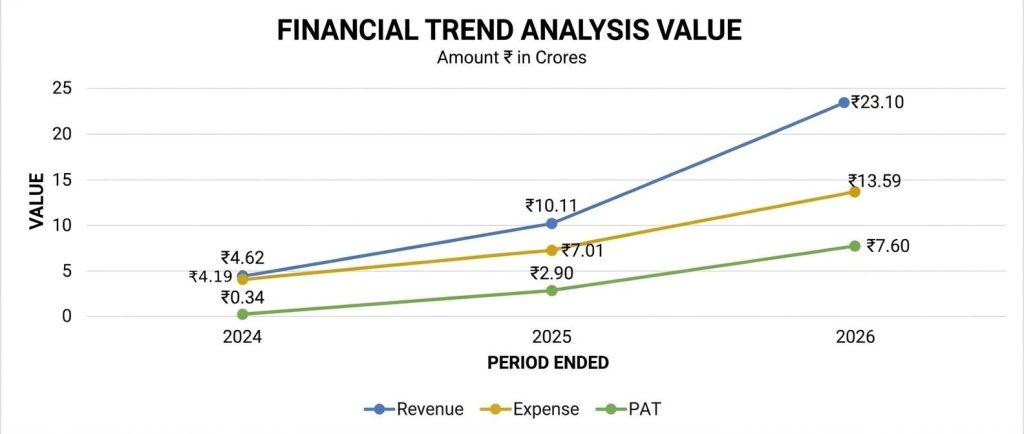
On the financial performance front, for the last three fiscals, the company has posted total income/ net profit, of Rs. 4.62 cr. / Rs. 0.34 cr. (FY24), Rs. 10.11 cr. / Rs. 2.90 cr. (FY25), Rs. 23.10 cr. / Rs. 7.60 cr. (FY26). Boosted top and bottom lines, and higher trade receivables for FY25 and FY26 raises concerns. It is operating in a highly competitive and fragmented segment.
For the last three fiscals, the company has reported an average EPS of Rs. 8.87 (basic), and an average RoNW of 42.79%. The issue is priced at a P/BV of 6.30 based on its NAV of Rs. 25.22 per share as of March 31, 2026, and at a P/BV of 2.95 based on its post-IPO NAV of Rs. 53.86 per share at the upper cap.
If we attribute FY26 super earnings to its post-IPO fully diluted paid-up equity capital, then the asking price is at a P/E of 19.49, and based on FY25 earnings, the P/E stands at 50.96. The issue appears aggressively priced based on its recent super earnings. Its P/E stood at attractive level based on its FY26 super earnings. Sustainability of such earnings going forward raise concern due to highly competitive and fragmented segment.
The company has posted PAT Margins of 7.50% (FY24), 28.79% (FY25), 32.99% (FY26), and RoCE margins of 12.41%, 29.92%, 45.60%, respectively for referred periods. Its outperforming PAT margins data for FY26 compared to listed peers is a big surprise.
All amounts in Indian Rupees crores
The company has not paid any dividends for the reported periods of the offer document. It will adopt a prudent dividend policy, based on its financial performance and future prospects.
Comparison with Listed Peers
As per the offer document, the company has shown PhysicsWallah, MPS Ltd., Verand Learning, and Arihant Academy as its listed peers. They are currently trading at a P/E of NA, 24.4, 94.9, and 30.9 (as of July 28, 2026). However, they are not truly comparable on an apple-to-apple basis. This comparison appears to be an eyewash.
Merchant Banker's Track Record
This is the 22ndh mandate from Narnolia Financial Services in the last three fiscals (including the ongoing one). Out of the last 10 listings, 3 opened at discount and the rest with premium ranging between 18.39% and 90.00% on the date of listing.
Conclusion
As claimed, FKEL is operating a scalable, hybrid learning ecosystem with online and offline play for B2B segment. It is operating in a highly competitive and fragmented segment. The company marked progress in its top and bottom lines, but super profits for FY26 raise eyebrows and concern over its sustainability going forward. Based on its recent financial data, the issue appears aggressively priced. Small paid-up capital post-IPO indicates longer gestation period for migration. Only well-informed/cash surplus/risk seekers may park moderate funds for long term.
Dilip Davda is a veteran financial journalist associated with the Indian stock market since 1978. He has been contributing to print and electronic media on capital markets, insurance, and finance since 1985.
He is widely recognized for reviewing public issues and non-convertible debentures (NCDs) in the primary market. Drawing on over three decades of market experience and close interaction with merchant bankers, his reviews focus on detailed fundamental and financial analysis of companies, with a special emphasis on SME public issues.
Disclaimer: The information provided herein is solely for educational and informational purposes and does not constitute an offer, solicitation, or recommendation to buy or sell any securities. Readers are advised to consult a qualified financial advisor before making any investment decisions. Investments in the securities market are subject to market risks. The author does not intend to invest in the securities discussed.