Juniper Green Energy IPO Review
Juniper Green Energy Ltd. (JGEL) is among the top 10 largest renewable independent power producers (“IPPs”) in India in terms of Total Capacity as at March 31, 2026, where total capacity includes operational, under construction contracted and awarded projects. (Source: CRISIL Report) The company develop, build, operate and maintain utility scale renewable energy projects through our in-house EPC team and O&M team, and generate revenue through the sale of electricity to various off-takers, including central and state government-backed entities.
It commissioned first solar project with a capacity of 100 Megawatts (“MW”) (144.97 Megawatts peak (“MWp”)) in March 2020 and have since expanded its portfolio of projects to a Total Capacity of 7,910.20 MW (10,247.06 MWp) as at June 30, 2026. Apart from solar projects, its portfolio also includes wind energy projects and a focus on complex renewable energy projects, such as WSH and FDRE projects with BESS. JGEL is ranked as the second largest bidder in terms of total capacity won in WSH and FDRE tenders concluded between April 1, 2021 to March 31, 2026 and had a 96.80% conversion rate for WSH and FDRE tenders won between April 1, 2021, to March 31, 2026. (Source: CRISIL Report)
As part of its in-house capabilities, the company manages the end-to-end lifecycle of renewable energy project development across all critical stages, including: (i) bidding and auction; (ii) site prospecting; (iii) land acquisition and grid permits; (iv) engineering and technology; (v) procurement; (vi) project financing; (vii) plant construction and commissioning; and (viii) O&M. It adopts a selective and strategic approach to auctions, backed by in-depth regulatory and commercial analysis, identify high-potential sites using Geographic Information System (“GIS”) tools, irradiance datasets and wind resource assessments. Its dedicated project development team has built a substantial land bank and its business development team has secured surplus grid connectivity to support future growth. Engineering and technology design is handled internally by a team of specialists covering layout, balance of plant, turbine technology and battery storage systems. Procurement is managed through long-term relationships and advance orders with global suppliers, ensuring both quality and timely availability of equipment.
By integrating EPC and O&M functions in-house, it retains construction margins typically passed to third-party contractors. This integrated execution model enhances control over timelines, cost and quality, while enabling it to offer competitive bids and achieve higher profitability. It also gives it the flexibility to tailor project designs and technology choices to suit specific site and project requirements, ensuring seamless execution from design to long-term operations. This integrated approach not only streamlines execution across the project lifecycle but also translates into measurable outcomes on the ground. It has an established track record of commissioning projects ahead of schedule. The company has commissioned Operational Projects ahead of schedule by a weighted average of 147 days, with one of its solar Operational Projects commencing 552 days ahead of schedule and one of wind Operational Projects commenced 222 days ahead of schedule on a weighted average basis.
The company has a proven ability to secure land and obtain grid connection approvals in advance. As at June 30, 2026, it had sufficient connectivity available for Under Construction Projects. Even after allocating grid permits to all its Under Construction Projects, it has surplus connectivity available to further operations. This is significant considering the current scenario that if a developer applies for connectivity today in Rajasthan/Gujarat (i.e., RE rich states), the connectivity may not be available till Fiscal 2030. (Source: CRISIL Report) Further, it has an existing land bank of more than 120002 acres for the installation of solar projects and more than 3002 WTG locations in states like Rajasthan, Maharashtra, Gujarat and Madhya Pradesh, which have high renewable energy resources potential (“RE Potential Zones”).
As at June 30, 2026, it had a diverse base of off-takers, comprising central government entities such as SECI, SJVN, NHPC and NTPC, state government entities like GUVNL and MSEDCL, and private entities such as The Tata Power Company Limited (“TPCL”). As at June 30, 2026, 97.68% of its Total Capacity (in terms of MWp) is backed by long-term PPAs which are typically for 25 years with creditworthy counterparties with ratings of “A” or above, providing visibility on stable and predictable cash flows with the balance comprising merchant projects. As of June 30, 2026, all PPAs are for 25 years save for the PPA entered into by Juniper Green Ray Two Private Limited which is for 20 years. Furthermore, it has the shortest receivable days for each of the Fiscals 2026, 2025 and 2024 compared to other listed industry peers (Source: CRISIL Report), with its receivables period being 21.88 days, 16.94 days and 23.06 days over the same years, respectively.
As at June 30, 2026, it has established strategic, long-term partnerships aimed at mitigating supply chain risks and ensuring sustainable operations and maintenance for its projects. These include a WTG supply agreement with Envision and a wind operated electricity generator (“WOEG”) supply agreement with Suzlon Energy Limited (“Suzlon”); solar module tie-ups with First Solar (for around 1.60 years), Waaree (for around 2.20 years) and Goldi (for around 2.20 years), inverter supply from Sungrow (India) Private Limited (“Sungrow”); SVGs tie up with TBEA Xi’an Electric Technology Co. Ltd. (“TBEA”) and BESS with Envision. These collaborations enhance its supply chain resilience, support timely project execution and ensure long-term operational reliability. As of June 30, 2026, it had 733 employees on its payroll and additional 75 contract employees.

Issue Details / Capital History
The company is coming out with its maiden book building route IPO worth Rs. 1800.00 cr. (approx. 80000000 equity shares at the upper band). The company has announced a price band of Rs. 214 – Rs. 225 per equity shares of Rs. 10 each. The issue opens for subscription on July 30, 2026, and will close on August 03, 2026. The minimum application to be made is for 66 shares and in multiples thereon, thereafter. Post allotment, shares will be listed on BSE and NSE. The issue constitutes 14.06% of the post-IPO paid-up equity capital. From the net proceeds of the issue, the company will utilize Rs. 683.24 cr. for repayment/prepayment of certain borrowings, Rs. 728.69 cr. for investment in its subsidiaries, and the rest for general corporate purposes.
The company has reserved equity shares worth Rs. 2.00 cr. (approx. 88889 equity shares at the upper cap) and offering them a discount of Rs. 21 per share. From the rest, it has allocated not more than 50% for QIBs, not less than 15% for HNI investors and not less than 35% for Retail investors.
The joint Book Running Lead Managers (BRLMs) to this issue are ICICI Securities Ltd., HSBC Securities and Capital Markets (India) Pvt. Ltd., JM Financial Ltd., Kotak Mahindra Capital Cr. Ltd., while KFin Technologies Ltd. is the registrar to the issue. J M Financial Services Ltd., and Kotak Securities Ltd. are the syndicate members.
After issuing initial equity shares at par value, the company has issued further equity shares in the price range of Rs. 310 – Rs. 1163.84 between June 1012, and March 2025. It has also issued bonus shares in the ratio of 10 for 1 in March 2025. The average cost of acquisition of shares by the promoters is Rs. 67.20 per share.
Post-IPO, its current paid-up equity capital of Rs. 488.99 cr. will stand enhanced to Rs. 568.99 cr. Based on the upper cap of the price band, the company is looking for a market cap of Rs. 12802.26 cr.
IPO Lead Managers & Registrar
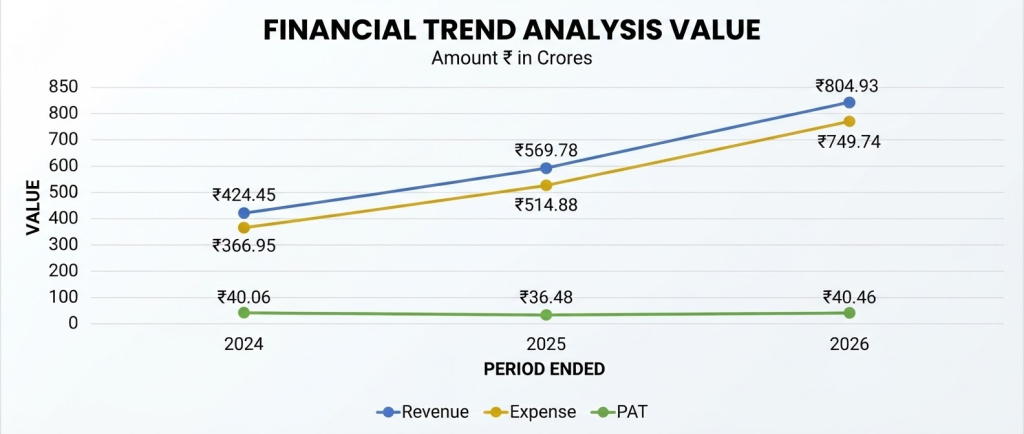
On the financial performance front, for the last three fiscals, the company has (on a consolidated basis) posted a total income/net profit of Rs. 424.45 cr. / Rs. 40.06 cr. (FY24), Rs. 569.78 cr. / Rs. 36.48 cr. (FY25), and Rs. 804.93 cr. / Rs. 40.46 cr. (FY26). The company posted growth in its top lines for the reported periods, but its bottom line marked inconsistency. Its contingent liabilities of Rs. 2210.51 cr. as of March 31, 2026 raise alarm.
For the last three fiscals, the company has posted an average EPS of Rs. 1.06 and an average RoNW of 1.34 %. The issue is priced at a P/BV of 3.21 based on its NAV of Rs. 70.02 as of March 31, 2026, and at a P/BV of 2.45 based on its post-IPO NAV of Rs. 91.81 per share at the upper cap.
If we attribute FY26 earnings to its post-IPO fully diluted paid-up equity capital, then the asking price is at P/E of 316.90. Based on FY25 earnings, the P/E stands at 351.56. The issue appears aggressively priced. According to the management, with clear visibility of long term income and cash generation with 25 yrs. PPA (Power Purchase Agreements) and the orders on hand, it is poised for bright prospects ahead.
For the reported periods, the company has not shown data for its PAT Margins and RoCE margins.
All amounts in Indian Rupees crores
IPO Valuation Matrix
The Company operates in the renewable power sector, which is characterized by stable and predictable EBITDA and operating cash flows. However, Profit After Tax (PAT) typically scales up as assets mature, due to the impact of depreciation and financing costs being higher in the initial years. As the portfolio matures, profitability is expected to improve meaningfully, a trend that is already visible in its financial performance so far.
The Company has demonstrated industry-leading growth, along with strong cash RoI and cash RoE matrix, supported by attractive project payback periods and high-quality contracted cash flows.
From a valuation perspective, while the P/E multiple may not be the most lucrative metric at this stage, given the early vintage of assets, the IPO valuation appears compelling on other relevant parameters. On a Price-to-Book basis, the Company is reasonably valued.
Given these factors, the Company’s medium- to long-term outlook remains very strong. It represents a unique opportunity to participate in India’s energy transition, and is also a direct beneficiary of the increasing power demand driven by AI adoption, digital infrastructure expansion, and decarbonization initiatives by Indian corporates. Recent budget has also favored renewable energy segment with more allocation of funds.
Dividend Policy
The company has not paid any dividends for the reported periods of the offer document. It has already adopted a dividend policy in June 2025, based on its financial performance and future prospects.
Comparison with Listed Peers
As per the offer document, the company has shown Acme Solar, NTPC Green, Adani Green, as its listed peers. They are currently trading at a P/E of 51.5, 130.0, and 119.0 (as of July 27, 2026). It has also shown global peer Renew Global Energy PLC. However, they are not truly comparable on an apple-to-apple basis.
Merchant Banker's Track Record
The four BRLMs associated with this issue have handled 94 IPOs in the last three fiscals out of which 28 issues closed below the issue price on the listing date.
Conclusion
JGEL is among the top largest renewable independent power producers in India. It has strong order book with long term PPAs for 25 years providing visibility of its income and cash flows. The company posted growth in its top lines for reported periods, but marked inconsistency in its bottom lines, which is attributed to higher provisioning for finance cost, depreciation and amortization. Based on its recent financial data, the issue appears aggressively priced, but considering its future bright prospects, it’s a pure long term story. Well-informed investors may park funds in this aggressively priced issue with a long term perspective.
Dilip Davda is a veteran financial journalist associated with the Indian stock market since 1978. He has been contributing to print and electronic media on capital markets, insurance, and finance since 1985.
He is widely recognized for reviewing public issues and non-convertible debentures (NCDs) in the primary market. Drawing on over three decades of market experience and close interaction with merchant bankers, his reviews focus on detailed fundamental and financial analysis of companies, with a special emphasis on SME public issues.
Disclaimer: The information provided herein is solely for educational and informational purposes and does not constitute an offer, solicitation, or recommendation to buy or sell any securities. Readers are advised to consult a qualified financial advisor before making any investment decisions. Investments in the securities market are subject to market risks. The author does not intend to invest in the securities discussed.










One Response
WHAT IS GMP.