

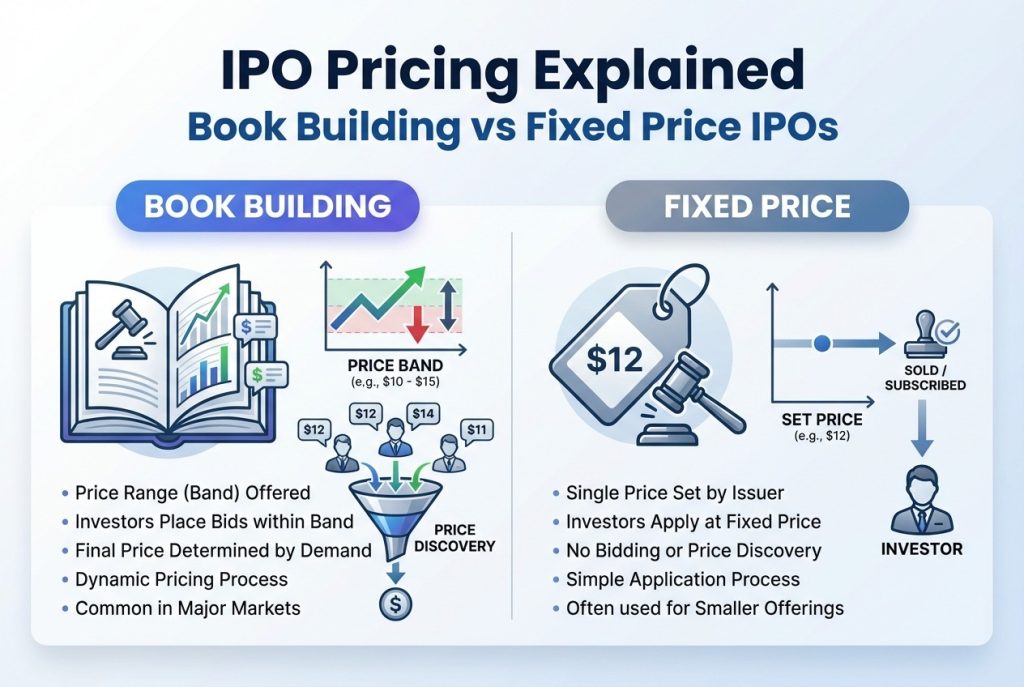
❖ What is the IPO Price?
When a company decides to launch its IPO, it decides the price of its shares, on which investors bid or apply for the company’s shares. Simply, an IPO price is the price that investors pay per share during the bidding process. There are 2 methods through which a company decides its IPO pricing, as follows: (1) Book-Building IPO, and (2) Fixed-Price IPO.
❖ What is a Book-Building IPO?
When you read that this IPO is a book-building IPO, this is what it means: when a company decides a price range (For eg, ₹100 to ₹110) rather than choosing just a single fixed price for its shares is called Book-building. Meaning investors get a chance to bid for the IPO within that price range. This IPO pricing method usually helps the company determine the final price/cut-off price based on investors’ demand. The book-build ipo method is usually used by mainboard IPOs.
❖ Let’s understand this properly with a live example:
Recently, one of the largest producers of Coking coal, Bharat Coking Coal (BCCL), launched its IPO with a price band of ₹21–₹23 per share. This is a Book-Build ipo. An investor can choose to apply for an IPO within the price range of ₹21, ₹22, or ₹23. After the IPO closes, the final issue price or cut-off price is decided based on the demand received at different prices.
In a book-building IPO, the lowest price an investor can bid is known as the floor price, or the lower end of the price band. The highest price the investor can bid for is known as the Cap price or upper end of the price band.
❖ How is the share price decided in a Book-Building IPO?
1. Price band is decided:
At the time of the launch of the IPO, the company decides on a price band mentioned in the ipo prospectus, for eg, ₹72 to ₹76.
2. Investor applies for the bid:
Investors then apply for the IPO within the price range of ₹72 to ₹76.
3. Demand is recorded:
Investors’ bids on the different price levels are collected during the IPO.
4. The cut-off price is decided:
The price at which most investors bid is set as the cut-off price or final-issue size. For eg, from the price range of (₹72 to ₹76), at ₹76, the company received the most bids, meaning most of the investors applied for the IPO at the upper end of the price range.
5. Allotment received at the cut-off price:
Investors who applied for the IPO at the cut-off price will receive the IPO allotment. If ₹76 is the cut-off price, and if you bid below the cut-off price, then you will not get allotment.
❖ What is a fixed price IPO?
As its name suggests, in a Fixed Price IPO method, the company offers its shares at a fixed price. Unlike a Book-Build IPO, where the company gives a price range between 2 numbers to choose from. In a Fixed Price IPO, investors can only bid for 1 fixed price set by the company. In a fixed price IPO, the share size is fixed (For eg, 72) before the IPO opens for subscription. The fixed price IPO method is usually preferred by SME companies due to its smaller size.
❖ Let’s understand this better with a live example:
Kanishk Aluminium, one of the leading aluminium extrusion manufacturers, recently launched its IPO with a fixed price of ₹73 per share. Meaning the investors can only bid for the shares of the company at a price of ₹73 only. Unlike a book-build ipo, in a fixed price ipo, investors can only apply for the IPO at the predetermined price.
❖ Difference Between Book Building and Fixed Price
| Book-Building IPO | Fixed Price IPO |
| In Book-Build, the company defines a price band for its shares(e.g., ₹100–₹110) | In a Fixed Price IPO, a fixed price is decided (e.g., ₹100) |
| Introduced by SEBI in 1995 for well-managed pricing. | The traditional method of ipo pricing |
| Investors submit a willing bid within the price range | Investors can buy shares only at a fixed price |
| The final price is decided based on the investor’s demand | The final price is pre-fixed by the company |
| This ipo pricing is mostly used by large and mainboard IPOs | This ipo pricing is mostly used by small and SME companies |
| Book-Build issue allows market-driven pricing | Fixed price issue gives certainty to investors |
| Book-Build issue is more popular in India | The fixed price issue is less popular in India |
| Investors can check the demand for each price during the IPO | Investors cannot check the demand until the IPO closes |
| Lower risk of mispricing as the final price is decided as per the investor’s demand | Higher risk of mispricing (Undervaluation or overvaluation) as pricing is pre-fixed. |
Frequently Asked Questions
The book-building IPO method is commonly used in India, especially for large companies, which mostly prefer this method.
– Book-build IPO carries lower risk as the final price is determined as per market demand.
– Fixed price IPO carry a higher risk as the price is pre-determined, leaving room for overvaluation or
undervaluation.
Yes, investors can apply for both a book-build ipo and a fixed price ipo through UPI or ASBA.
When a company offers its shares in a price band (for example, ₹100–₹110) is called a book-build IPO. Investors can bid for an IPO within this price range.
When a company offers its shares with a single fixed share price (for example, ₹100) is known as a fixed price IPO. An investor can only apply for an IPO at a fixed price.